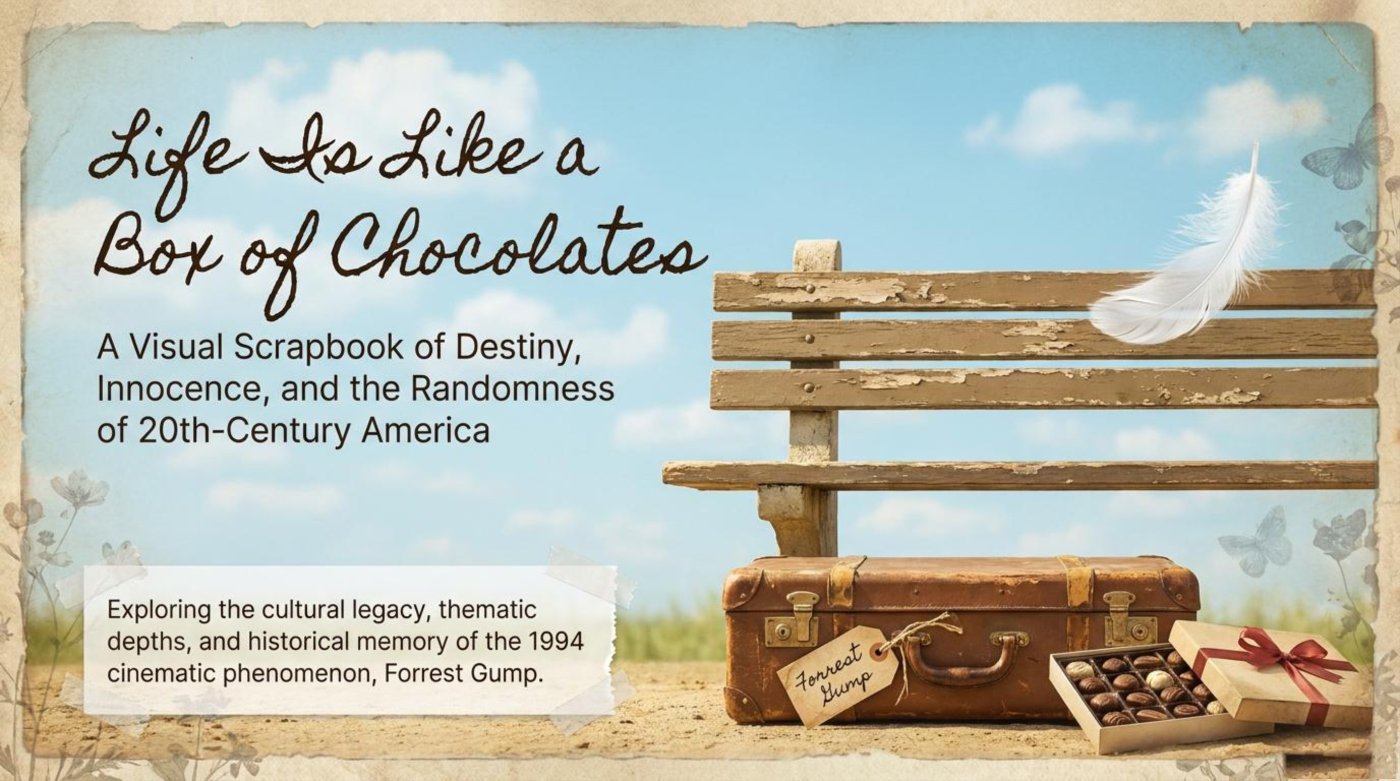
🍫 Life Like a Box of Chocolates:
Decoding the Accidental Wisdom of Forrest Gump
“Life was like a box of chocolates. You never know what you're gonna get.”
A language‑learning journey through destiny, innocence, and the nostalgic pulse of 20th‑century America
There is a moment in the 1994 film Forrest Gump that captures the entire essence of the American experience: a white feather drifts through the sky, twists in the breeze, and lands at the feet of a man waiting for a bus. The audience immediately senses that something profound is about to be shared. This film, adapted from Winston Groom's 1986 novel, transforms an unassuming character into a living mirror of the 20th century. The lesson presented here explores why this cinematic phenomenon remains a cultural touchstone. It is a testament to the idea that simplicity can unravel the biggest mysteries of life, history, and language.
🎬 A Half‑Century Under One's Feet
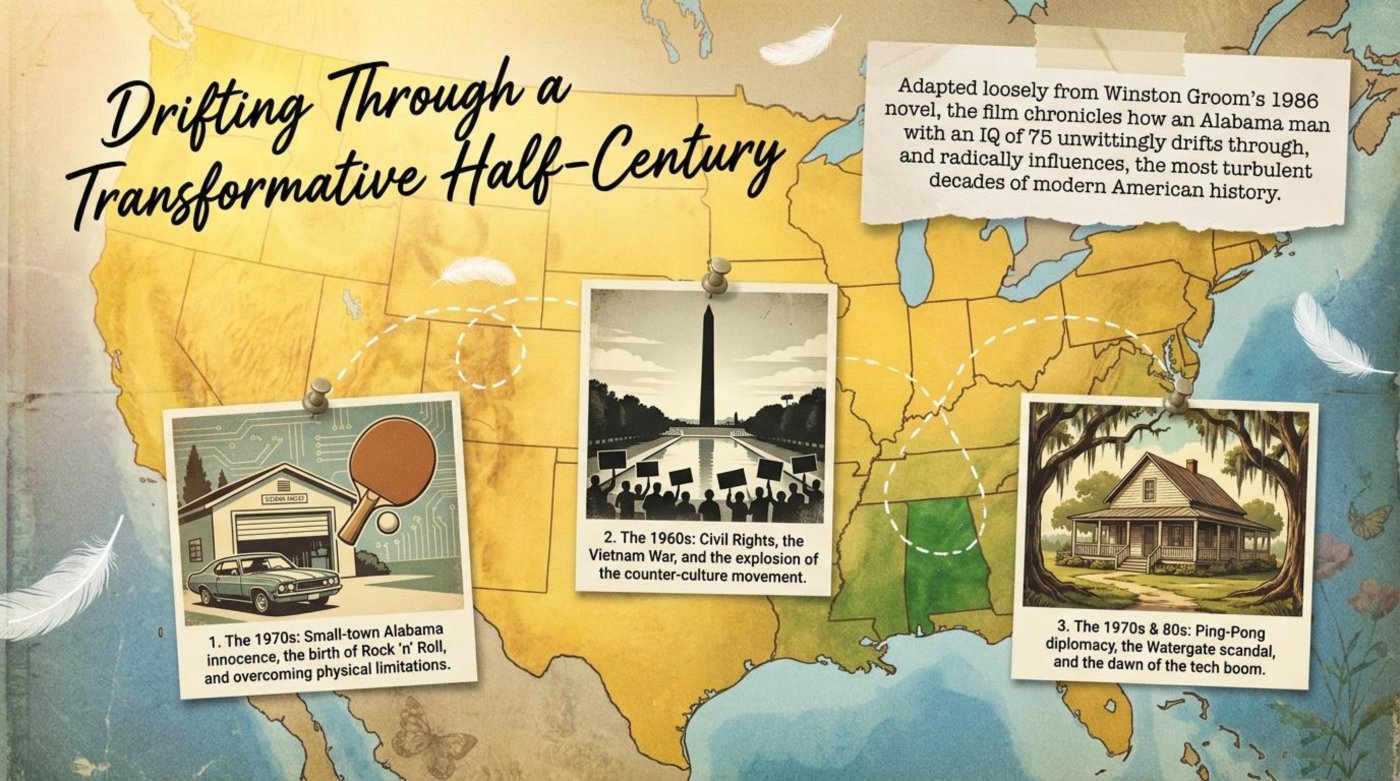
The PDF presentation for this class maps out the geographical and historical journey of the film with remarkable clarity. It shows three main arcs: the 1950s small‑town Alabama innocence accompanied by the birth of rock 'n' roll, the 1960s defined by Civil Rights and the Vietnam War, and the 1970s with the Watergate scandal, Ping‑Pong diplomacy, and the rise of the tech boom. The protagonist, a man with an IQ of 75, drifts through these pivotal decades, unwittingly influencing some of the most significant events in American history.
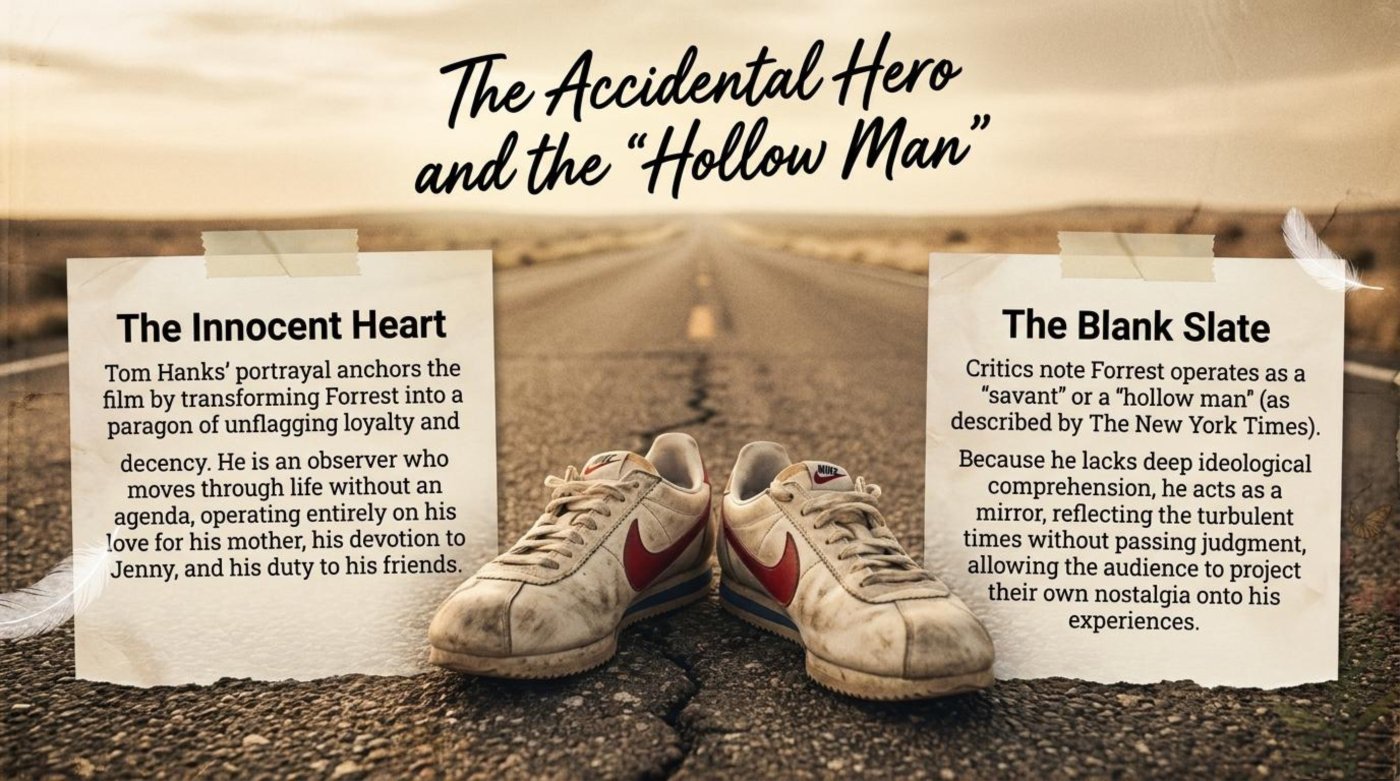
An important observation is that the film takes its protagonist's mental disability not as a weakness but as a lens of purity. As the presentation notes, the movie's protagonist has an "innocent heart," operating entirely on love for his mother, devotion to his childhood friend Jenny, and his sense of duty. This character is referred to as a "hollow man" in some critical circles, meaning he lacks an ideological agenda. Because of his blank slate, he reflects the turbulent times without judgment, allowing the viewer to project personal nostalgia onto his experiences. In the lesson, teacher Hannah noted, "I think Forrest Gump is autistic. He reads like a very autistic person to me." This perspective opens the door for a more inclusive and nuanced understanding of the film’s themes—traits such as radical honesty, literal interpretation, and unwavering emotional truth are all part of his accidental charisma.
🔍 The Two Faces of a Generation: Forrest and Jenny
The presentation gives a striking comparison between Forrest Gump and Jenny Curran. Forrest is driven by duty, loyalty, and unconditional love. His relationship to history is that of an accidental participant; he obeys authority (Army, colleges, Presidents), and he embodies traditional conservatism, innocence, and the endurance of the American Dream. Jenny, conversely, is driven by escape, radical freedom, and an identity crisis. She actively challenges authority through protests, the SDS, and the hippie movement. Her life becomes a symbol of the chaotic death of liberal innocence.
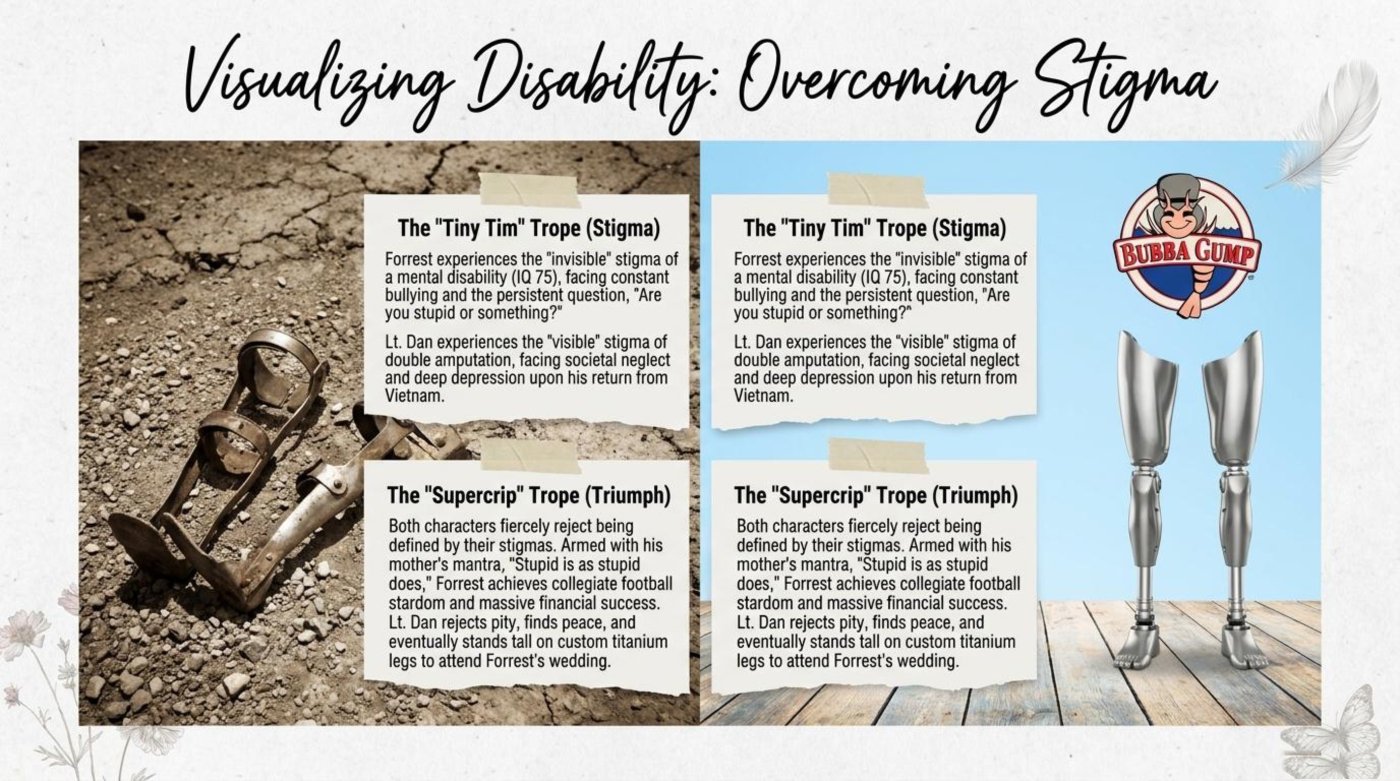
This duality is further reflected in the visual slides dealing with stigma. The presentation uses the term "Tiny Tim" trope to describe the invisible stigma of a mental disability and the visible stigma of physical disability. However, both Forrest and Lieutenant Dan reject being defined by their conditions. Forrest achieves stardom and financial success with his mantra "Stupid is as stupid does", and Lieutenant Dan eventually walks tall on custom titanium legs, finding peace and attending Forrest's wedding. The metaphor is powerful: the real "handicap" is being defined by a label.
🎶 A Nation in Song: Soundtrack of Innocence and Dissent
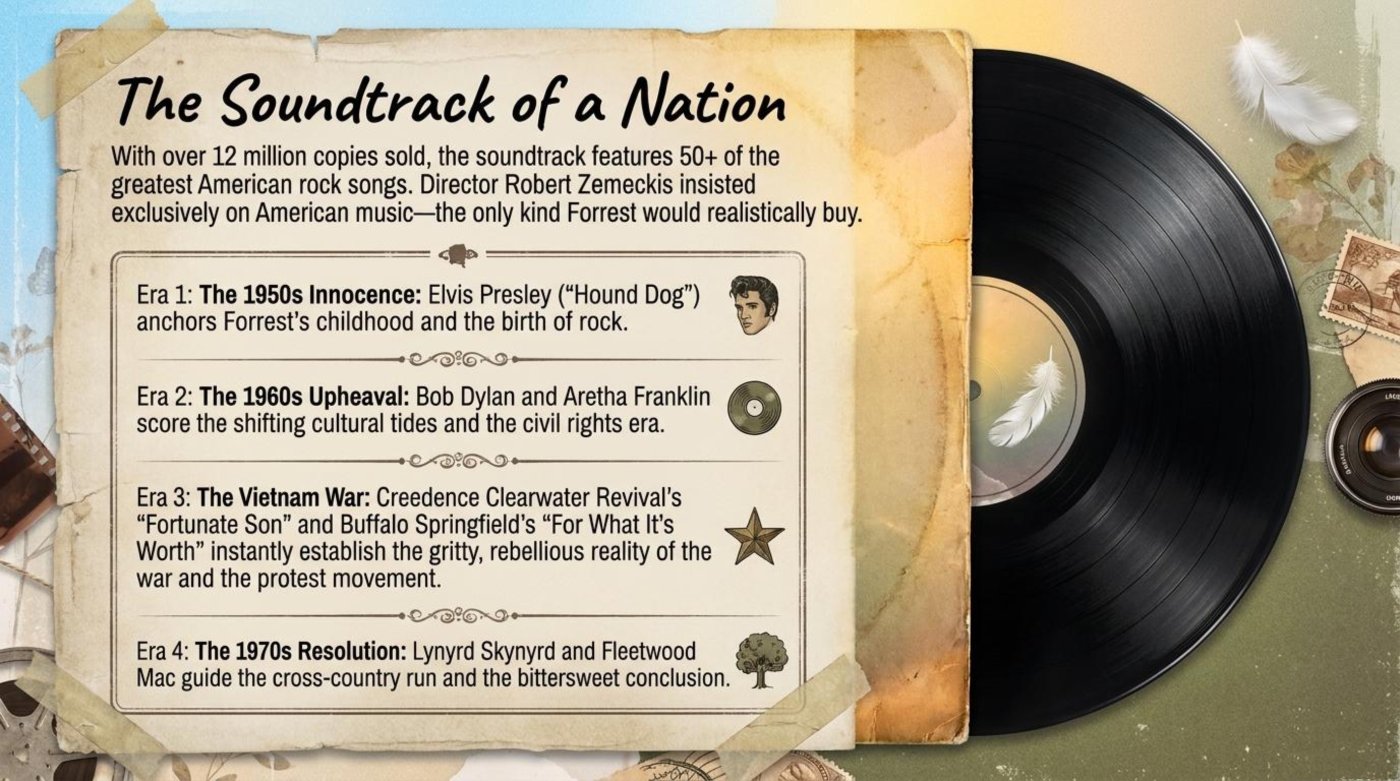
The film’s soundtrack is an essential character in itself. Director Robert Zemeckis insisted on using exclusively American music, the only kind Forrest would realistically buy. The presentation breaks this soundtrack into four distinct eras. The 1950s sees Elvis Presley's "Hound Dog" anchoring childhood innocence. The 1960s brings the upheavals of Bob Dylan and Aretha Franklin. The Vietnam War is channeled via Creedence Clearwater Revival's "Fortunate Son" and Buffalo Springfield's "For What It's Worth". Finally, the 1970s resolution uses Lynyrd Skynyrd and Fleetwood Mac to guide the cross‑country run and the bittersweet conclusion.
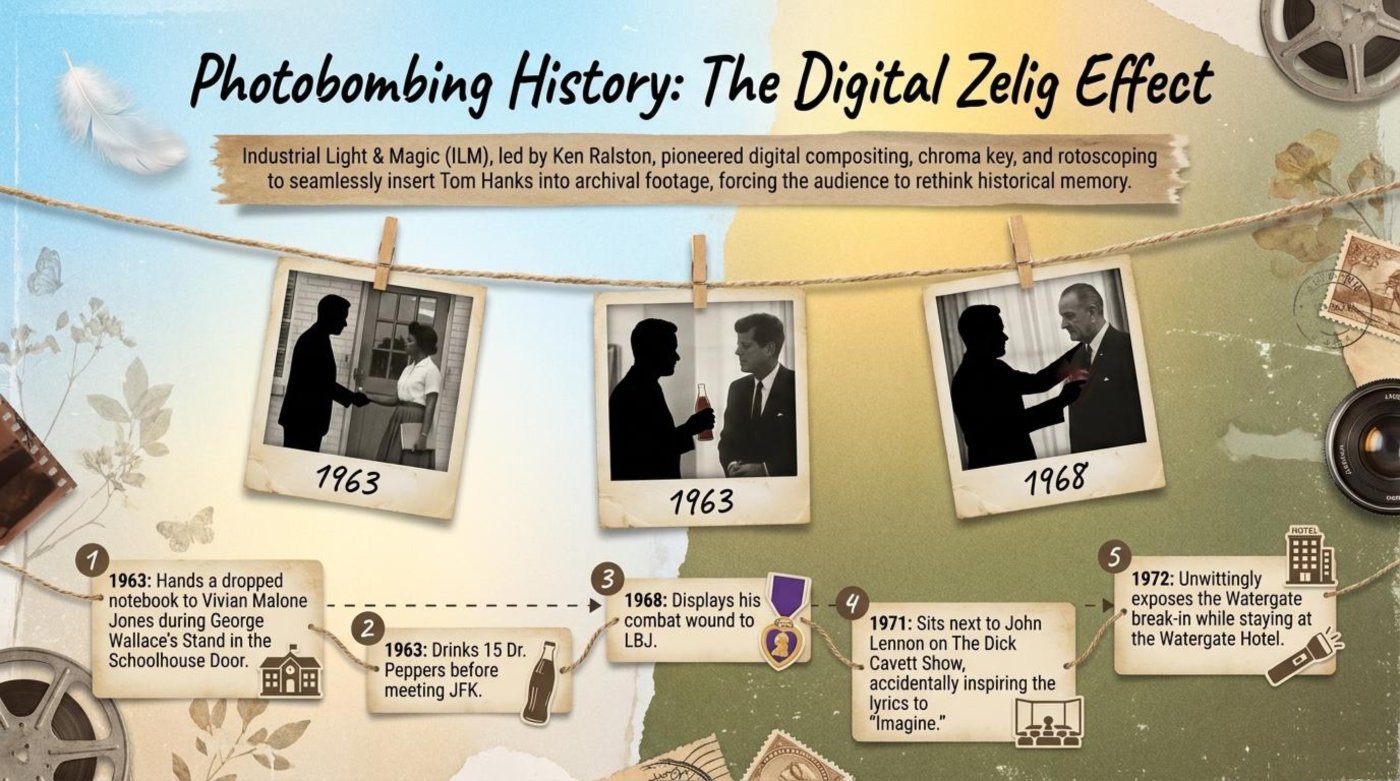
Additionally, the presentation highlights the role of Photobombing History, or the "Digital Zelig Effect." Industrial Light & Magic used digital compositing to insert Tom Hanks into archival footage. The slide shows how Forrest is seemingly involved in the 1963 George Wallace stand, hands a notebook to Vivian Malone, drinks Dr. Peppers before meeting JFK, displays his combat wound to LBJ, sits next to John Lennon on the Dick Cavett Show (accidentally inspiring the lyrics to Imagine), and unwittingly exposes the Watergate break‑in.
During the live session, the student Anatoly had the creative idea to invite an AI voice companion to role‑play Forrest Gump. This augmented the analysis with a dynamic fictional dialogue. When asked about the most memorable person he had met, the AI‑driven Forrest responded: "I've met a lot of folks, like presidents and fancy people, but if I have to pick, it's gotta be my mama. She's the one who taught me everything I know... She's the smartest person I know." This reinforces the human connection at the film’s core.
📌 Vocabulary and Language Takeaways
🎁 Box of chocolates
Literal meaning: A box containing assorted chocolates.
Figurative meaning: Life's unpredictability; you cannot control what happens but you must experience it.
Explanation: This is the film's most iconic quote. It teaches that accepting uncertainty is a gentle way to navigate the world. It also mirrors the English language concept of using familiar objects to explain abstract ideas.
🍃 Drifting through life
Literal meaning: Moving slowly without a fixed destination.
Figurative meaning: Letting life unfold without struggle or resistance.
Explanation: This phrase portrays the protagonist’s relationship with time. He does not force changes in history; he simply moves through them, which is why this phrase is associated with the English idiom "go with the flow."
🦿 Supercrip
Literal meaning: A person with a disability who achieves extraordinary feats.
Figurative meaning: A trope where disabled characters are used to teach able-bodied people lessons about bravery.
Explanation: This vocabulary term offers a critical perspective on representation. It encourages learners to examine how media uses characters like Forrest and Lt. Dan to explore vulnerability and resilience.
🕊️ Hollow man
Literal meaning: An empty container or a person without depth.
Figurative meaning: A character who acts as a blank slate, reflecting the audience's feelings rather than having their own complex motivations.
Explanation: This critical term helps learners discuss film theory. It shows that emptiness in literature can hold profound meaning, and that lack of judgment can be a form of emotional intelligence.
📉 Gritty realism
Literal meaning: Showing the harsh, unglamorous truth.
Figurative meaning: In art and film, it creates a feeling of authenticity, especially in war scenes.
Explanation: This phrase describes the film's visual and emotional tone. It’s a useful descriptor in everyday English for anything that does not hide its difficulties.
🔥 Metaphors, Symbols, and Key Ideas
The White Feather
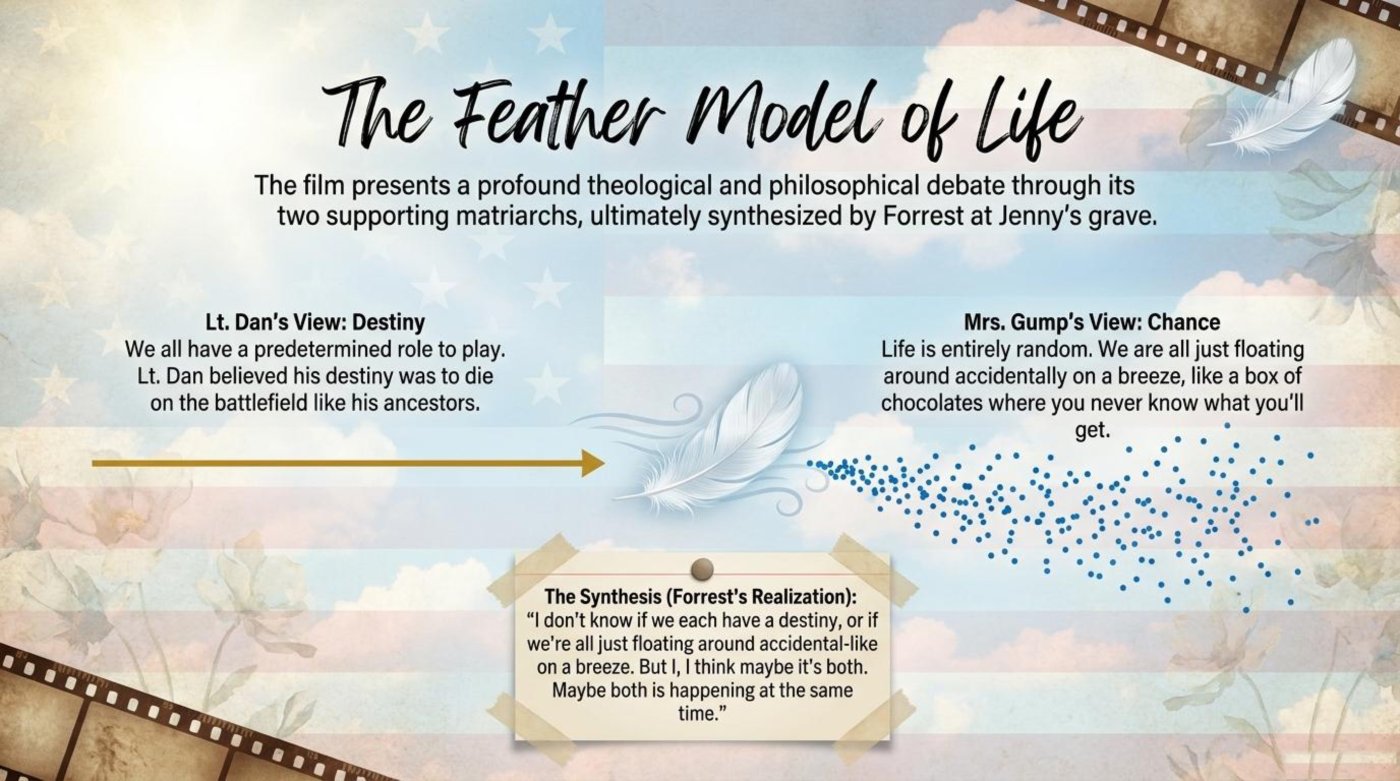
In the film, the feather drifts from the sky at the beginning and the end. The slide presents it as the "Feather Model of Life." This symbol asks us whether life is destiny or chance. Mrs. Gump tells Forrest, "Life is entirely random. We are all just floating around accidentally on a breeze." However, Lieutenant Dan believes in predetermined destiny. The final resolution from Forrest is: "Maybe it's both. Maybe both is happening at the same time." This philosophical synthesis is a superb lesson in English, as it uses simple words to express complex existential ideas.
The Leg Braces
The leg braces represent Forrest's physical limitation and childhood ridicule. In the slides, this is linked to the "Tiny Tim" trope. The braces are later discarded, symbolizing how the support systems of home and love give way to autonomous strength. The transformation from braces to running across the country showcases that human resilience is not about erasing vulnerability but about moving past it while keeping memory alive.
The Shrimp Boat (Bubba Gump)
The shrimp boat is the ultimate symbol of a promise fulfilled. Forrest promises his friend Bubba that he will become a shrimp boat captain. After Bubba dies in Vietnam, this promise becomes the engine of Forrest's economic success. The presentation notes that a hurricane destroys the competing boats, creating an instant monopoly. This element can be interpreted as capitalism being rewarded alongside personal loyalty. The symbolic power lies in the fact that a simple promise turned into a multinational business empire.
The Box of Chocolates
The box is the overarching metaphor for the entire film. It turns a sweet treat into a life philosophy. The slide highlights that the quote "Life is like a box of chocolates" became famous because it represents the need to accept events with honesty and sincerity. The lesson used this symbol to teach that all outcomes—good or bad—are part of the same package.
📚 Integrating the Lesson: Teacher's Commentary and Real‑Life Application
Throughout the lesson, teacher Hannah shared her Caribbean perspective on American history. She noted that she remembered the school desegregation scene where Forrest simply thought it was "really cool" that Black students could attend universities. She explained that his lack of prejudice was a form of profound kindness. The student Anatoly used AI to role‑play an English conversation, allowing the vocabulary and symbolism of the film to become alive in an interactive format.
For language learners, the practical advice from this lesson is to embrace ambiguity. Just as the audience never knows which chocolate they will get, a student never knows which new word or idiom will arise in a conversation. The learning strategy is to accept the unknown, absorb phrases from various media, and practice using them in open discussion.
🌍 The Political Rorschach Test: A Broad Learning Perspective
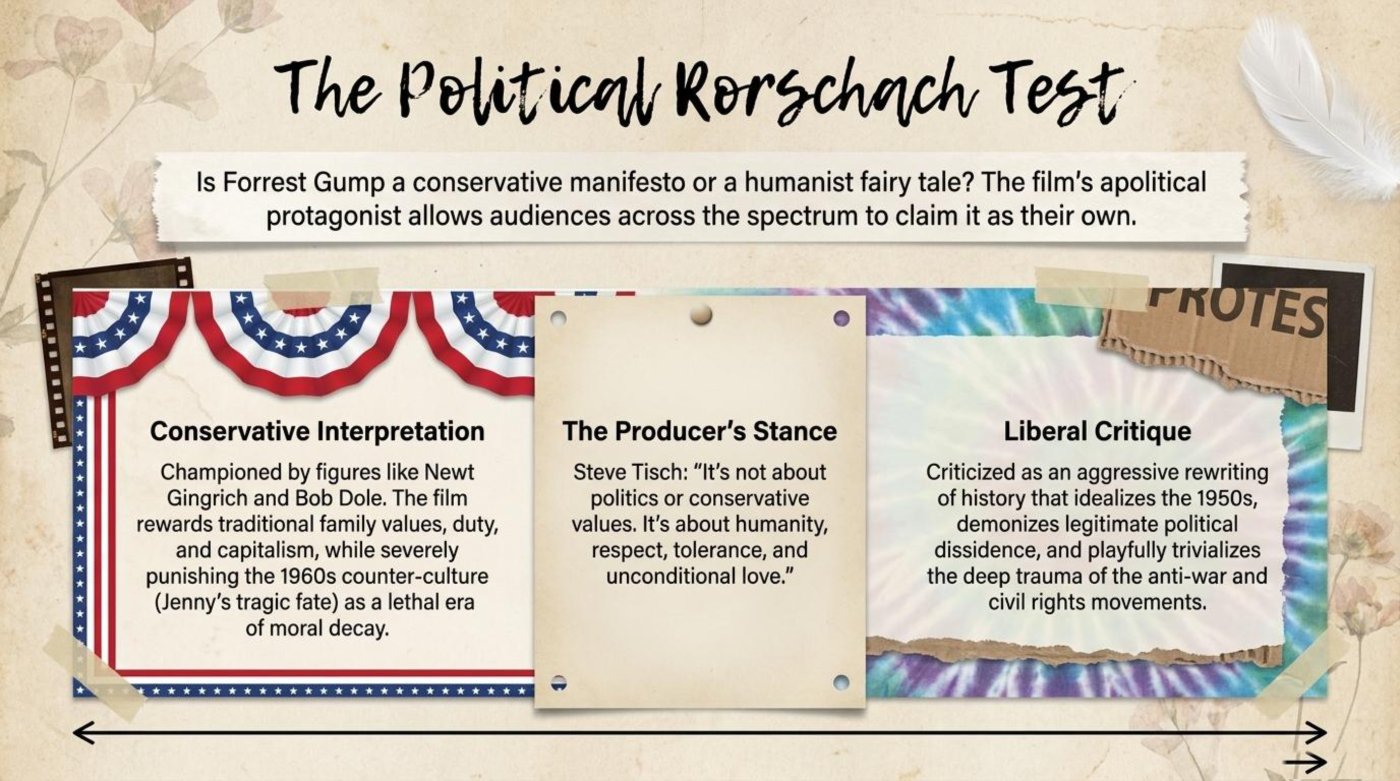
The presentation poses the question of whether this film is a conservative manifesto or a humanist fairy tale. It explains that audiences across the political spectrum claim it for their own. The producer Steve Tisch says: "It's not about politics or conservative values. It's about humanity, respect, tolerance, and unconditional love." This argument enriches an ESL learner's understanding of how English language narratives can be interpreted in diverse ways depending on historical context and personal belief. It also boosts critical thinking skills.
🎓 Conclusion: The Feather as a Call to Action
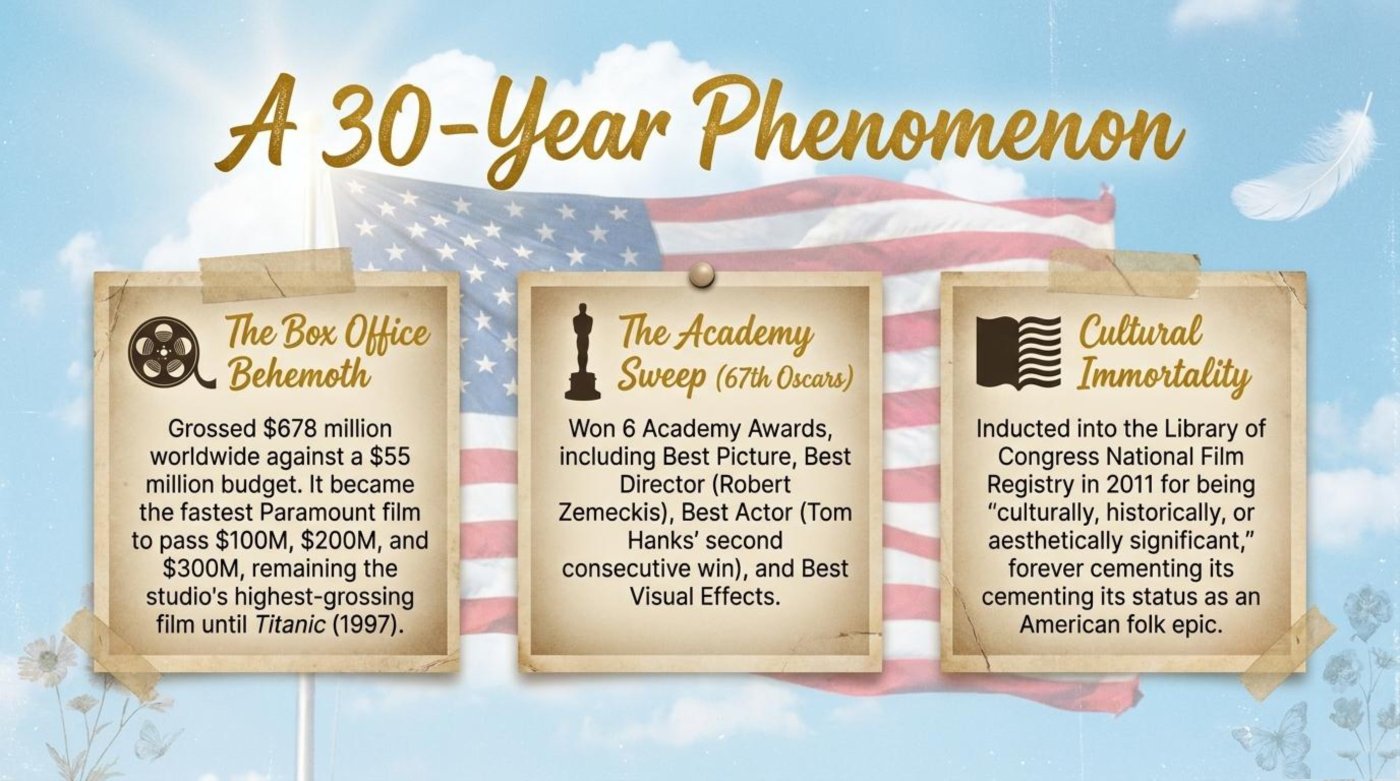
The final slide of the presentation synthesizes the true magic of the film: "Thirty years later, the true magic of Forrest Gump lies not in its digital tricks or its divisive politics, but in its profound humanity." It is a monument to unconditional love and resilience. Producer Wendy Finerman adds, "The childlike innocence of Forrest Gump is what we all once had... It does what movies are supposed to do: make you feel alive."
For anyone studying English, the call to action is to watch the film with new eyes. Notice the repeated use of "Mama says" or "Momma always said" as a language pattern for introducing life wisdom. Listen for the way the dialogue switches between simple past and present perfect to tell a life story. This visual scrapbook provides an extraordinary framework for learning history, vocabulary, and storytelling in one sitting. Engage with the original material, discuss it with a partner, and let the randomness of conversation transport you as the wind carries a feather across your screen.