🎬 Film History · English Lesson Digest
The Many Faces of the Opera Ghost: A Century of Phantom of the Opera Films (1925–2004) — and the English Hidden in Every Era
One novel, a century of movies — a guided journey through the story’s endless reinvention, with vocabulary, symbols, and language takeaways.
🎭 TONIGHT’S PROGRAMME
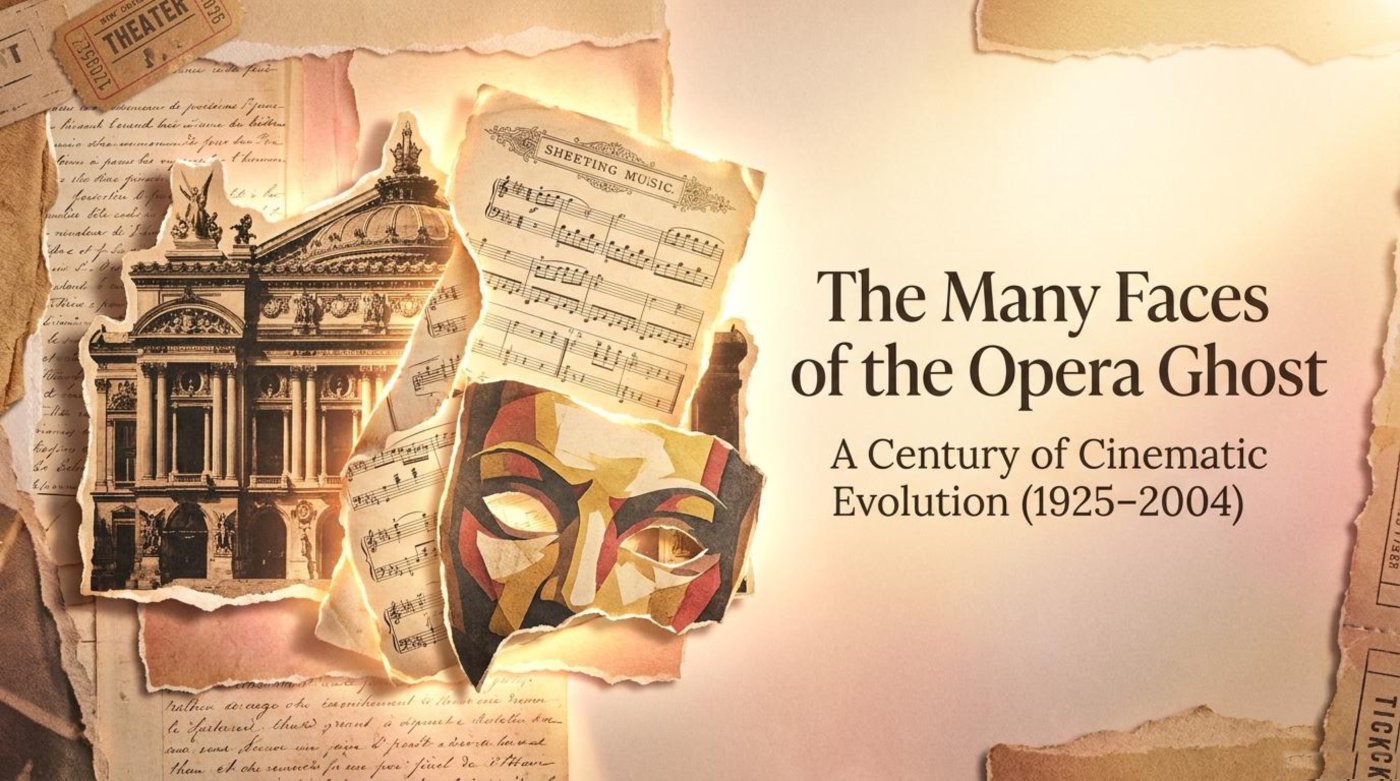
In 1925, moviegoers watching a silent black-and-white film reportedly screamed and fainted in their seats. The cause was a single moment of cinema: the second when a mysterious figure haunting the Paris Opera House pulled off his mask and revealed a face of pure horror. The presentation at the heart of this article opens with that electrifying piece of film history, and it uses the shock to launch a much bigger story — the story of how one character, the Opera Ghost, has been rebuilt for every generation of audiences for nearly eight decades.
The material, a richly illustrated deck titled “The Many Faces of the Opera Ghost: A Century of Cinematic Evolution (1925–2004),” was used in a live English lesson led by Kelyn, a teacher from Belize. Beyond its film history, the presentation is a genuine gift for language learners: it is packed with precise, expressive English about storytelling, comparison, and change over time. Reading it closely feels like a masterclass in how to retell a famous story in vivid, adult vocabulary.
Content and Context
One novel, a century of movies
The Source Code: Leroux’s 1910 Novel
Every adaptation begins with a book. The deck calls Gaston Leroux’s 1910 novel the source code of the entire legend, and it breaks the original story into three components. The novel’s framework is described this way:
“Presented as a journalistic quest to find evidence of the ‘Opera Ghost’ — treating the myth as a historical investigation.”
That framing device is remarkably clever: Leroux pretends his fantasy is a piece of investigative reporting, which makes the impossible feel documented and real. The human core of the story is described just as economically:
“Christine (originally blonde and blue-eyed) is driven by compassion; Raoul is passionate but often insecure, insensitive, and childlike.”
And the villain is painted without any softening:
“Erik is born deformed. He is corpse-like, violent, possessive, and genuinely horrifying. He is a genius architect and composer, but essentially a monster.”
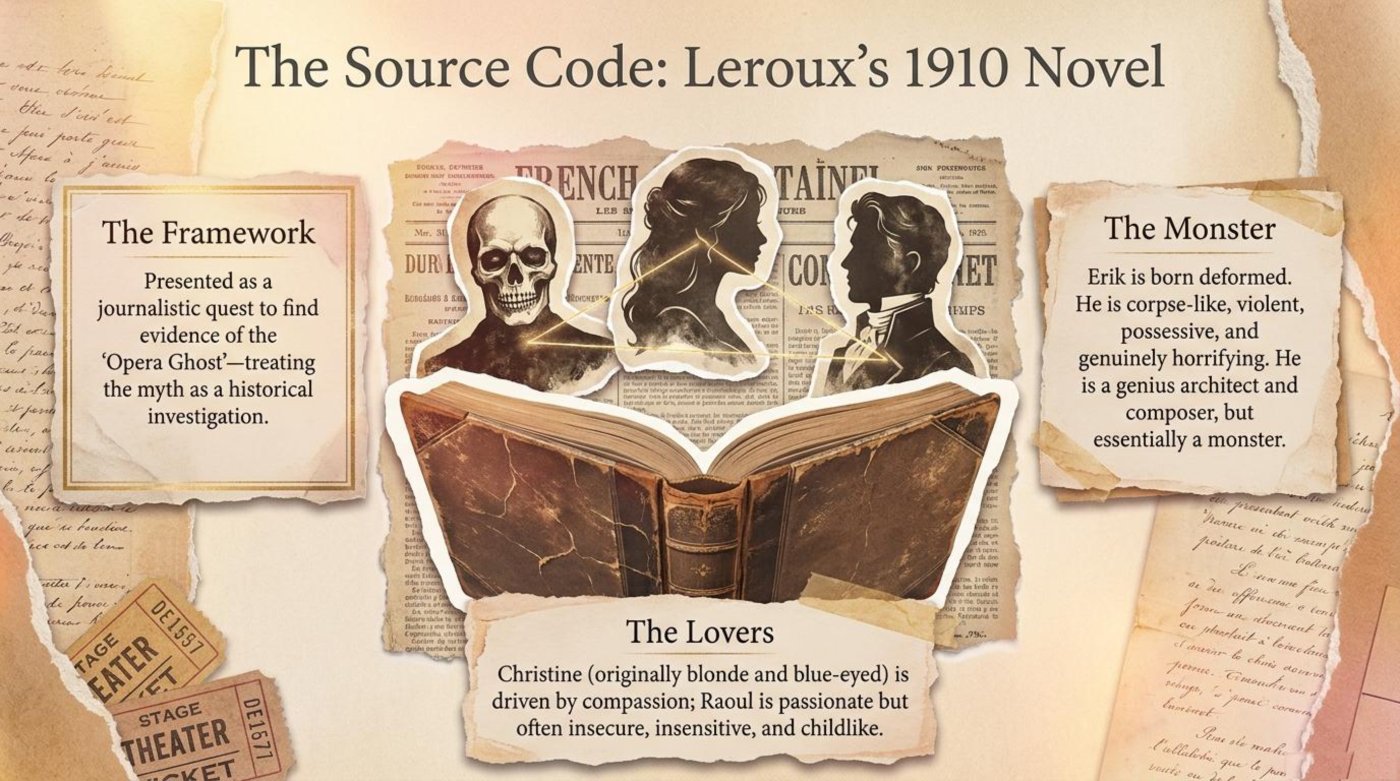
📌 Pay attention to the efficiency of these descriptions. Each sentence pairs a character with a short chain of adjectives — compassionate, passionate, insecure, corpse-like, possessive. This is exactly the skill learners need for book and film reviews: saying a lot with a few well-chosen words.
A Century of Mutation: The Cinematic Lineage
From that single source, the deck maps a whole family tree of films. The main line reads like a series of era labels: “1925: Silent Horror (Rupert Julian),” “1943: Technicolor Tragedy (Arthur Lubin),” “1962: Hammer Gothic Antihero (Terence Fisher),” “1989: Faustian Slasher (Dwight H. Little),” and “2004: Romantic Spectacle (Joel Schumacher).” Around that main line, the deck also plots side branches: a made-for-TV masterclass from 1983, a subdued drama from 1990, The Phantom Lover (1995), Giallo Horror (1998), and Love Never Dies (2012).
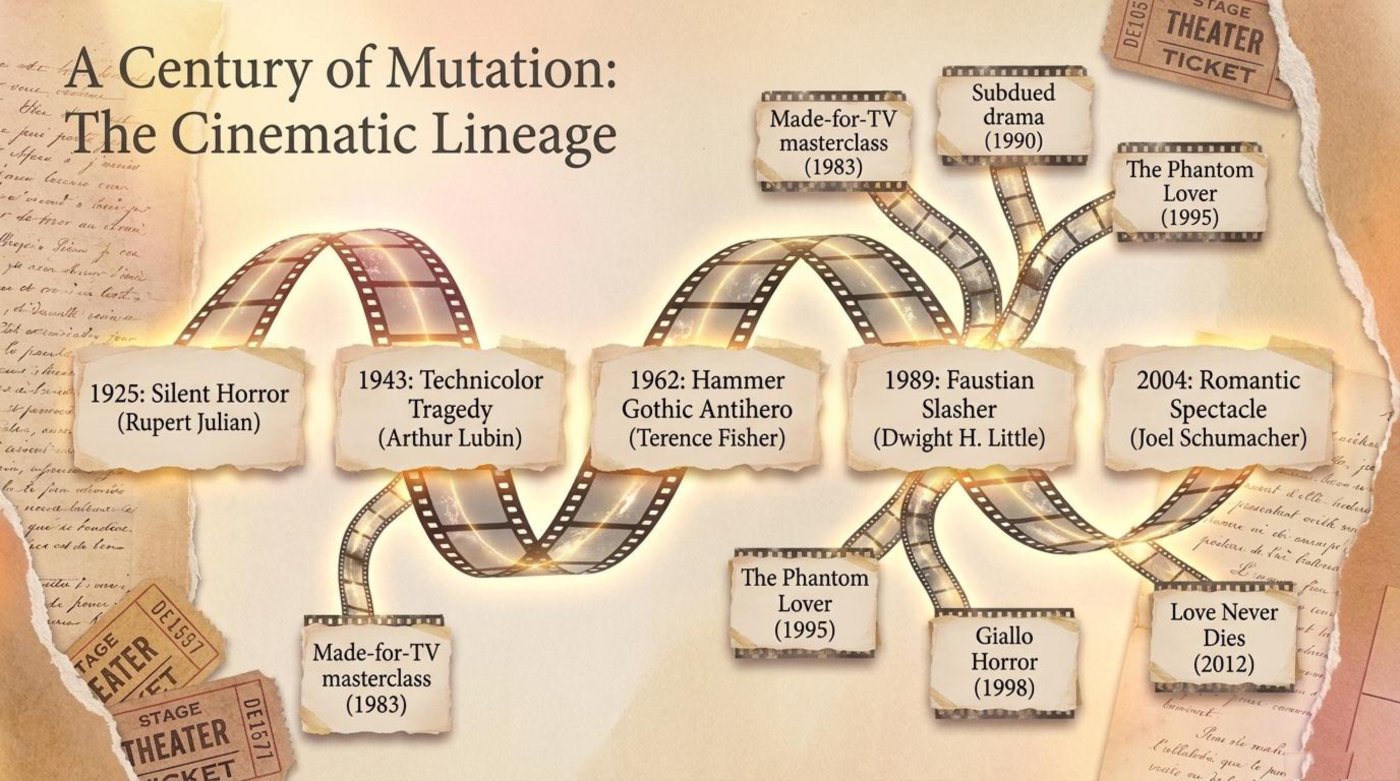
💡 Notice how the deck describes each film with a two-word genre label plus a year — silent horror, technicolor tragedy, romantic spectacle. This compact formula is a powerful tool for learners: it trains precision adjectives and lets you summarize an entire movie in a breath.
🎟️ 1925 · SILENT HORROR
The Birth of the Cinematic Monster
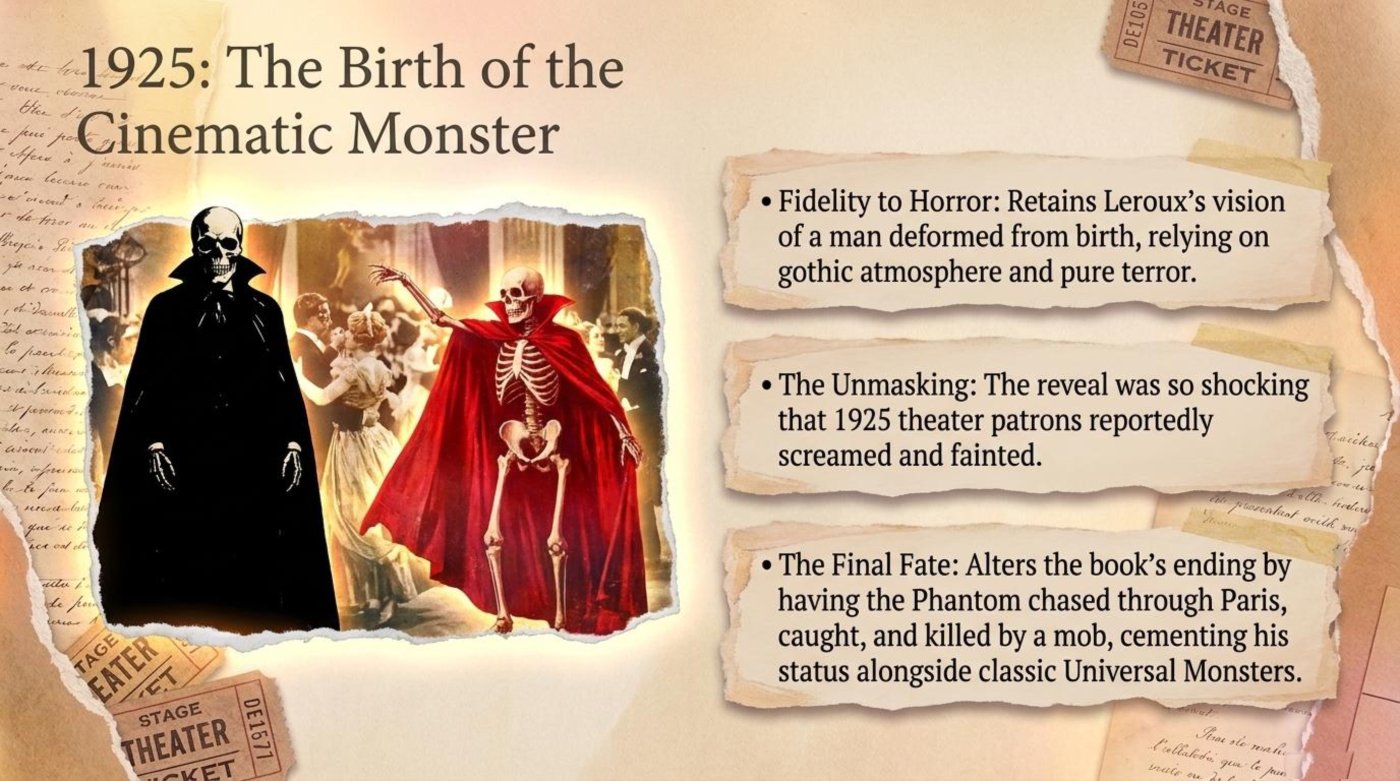
The first screen Phantom stays close to the book’s darkness. The deck explains the film’s fidelity to its source in one line:
“Fidelity to Horror: Retains Leroux’s vision of a man deformed from birth, relying on gothic atmosphere and pure terror.”
Its most famous scene entered cinema legend immediately:
“The Unmasking: The reveal was so shocking that 1925 theater patrons reportedly screamed and fainted.”
And its ending departs from the novel in a decisive way:
“The Final Fate: Alters the book’s ending by having the Phantom chased through Paris, caught, and killed by a mob, cementing his status alongside classic Universal Monsters.”
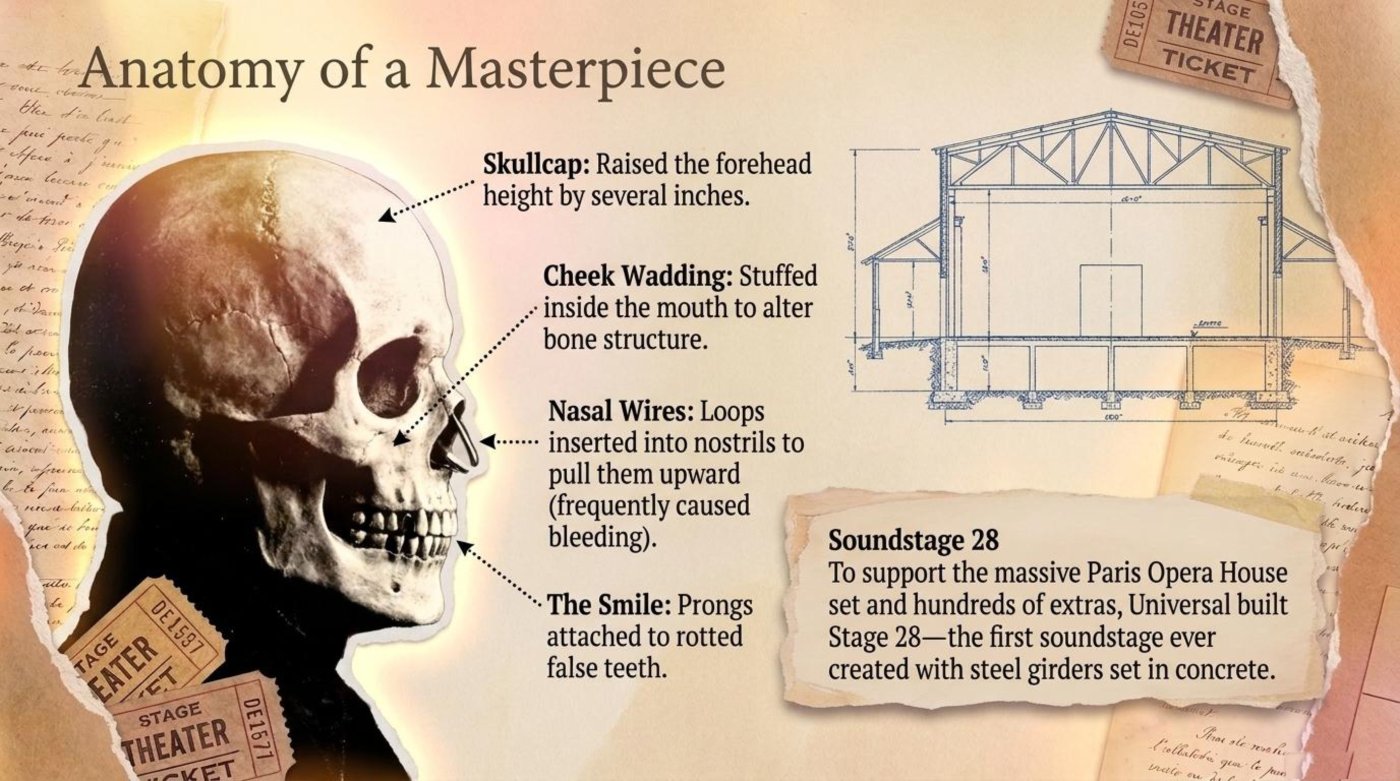
The deck then dissects the legendary make-up that produced the shock. Each component is described in the passive voice, like a laboratory report:
“Skullcap: Raised the forehead height by several inches.” — “Cheek Wadding: Stuffed inside the mouth to alter bone structure.” — “Nasal Wires: Loops inserted into nostrils to pull them upward (frequently caused bleeding).” — “The Smile: Prongs attached to rotted false teeth.”
The production ambition matched the make-up:
“To support the massive Paris Opera House set and hundreds of extras, Universal built Stage 28 — the first soundstage ever created with steel girders set in concrete.”
🎟️ 1943 · TECHNICOLOR TRAGEDY
The Tragic Hero Shift
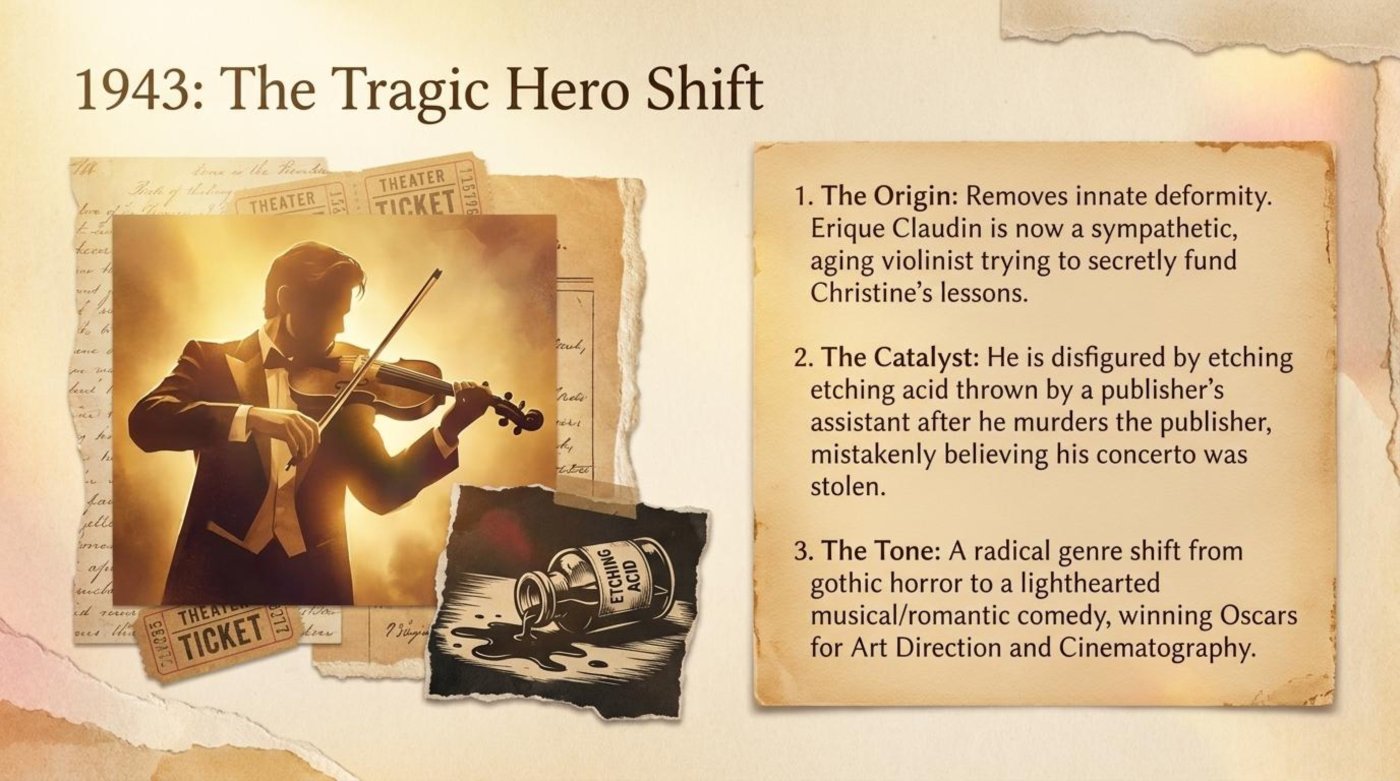
The second era performs surgery on the character. The deck lists three radical changes. First, the origin:
“The Origin: Removes innate deformity. Erique Claudin is now a sympathetic, aging violinist trying to secretly fund Christine’s lessons.”
Second, the turning point of the plot:
“The Catalyst: He is disfigured by etching acid thrown by a publisher’s assistant after he murders the publisher, mistakenly believing his concerto was stolen.”
Third, the atmosphere of the whole film:
“The Tone: A radical genre shift from gothic horror to a lighthearted musical/romantic comedy, winning Oscars for Art Direction and Cinematography.”
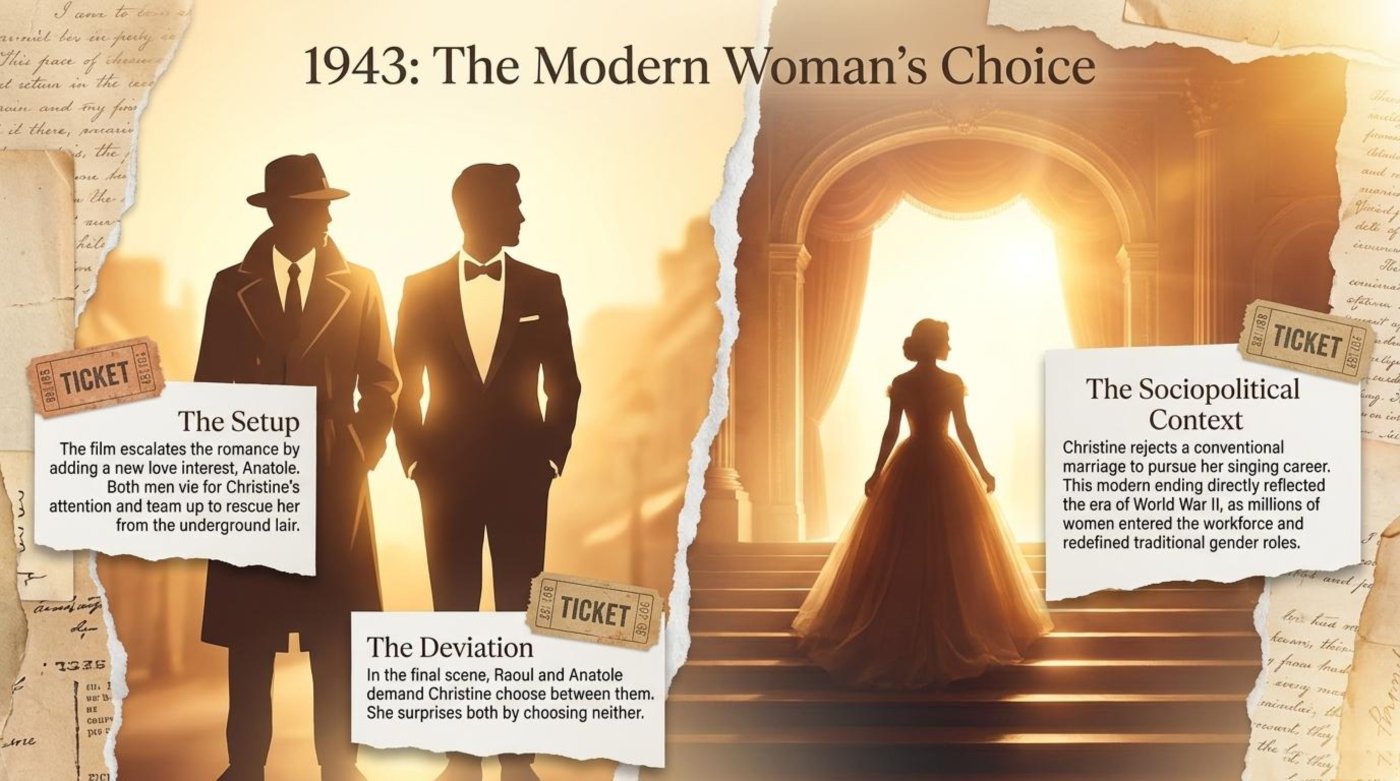
The romance is upgraded as well, and the ending delivers a genuine surprise. The deck describes the new triangle:
“The film escalates the romance by adding a new love interest, Anatole. Both men vie for Christine’s attention and team up to rescue her from the underground lair.”
Then comes the twist:
“In the final scene, Raoul and Anatole demand Christine choose between them. She surprises both by choosing neither.”
The deck connects that choice directly to history:
“Christine rejects a conventional marriage to pursue her singing career. This modern ending directly reflected the era of World War II, as millions of women entered the workforce and redefined traditional gender roles.”
🎟️ 1962 · HAMMER GOTHIC ANTIHERO
The Gothic Antihero of Hammer Films
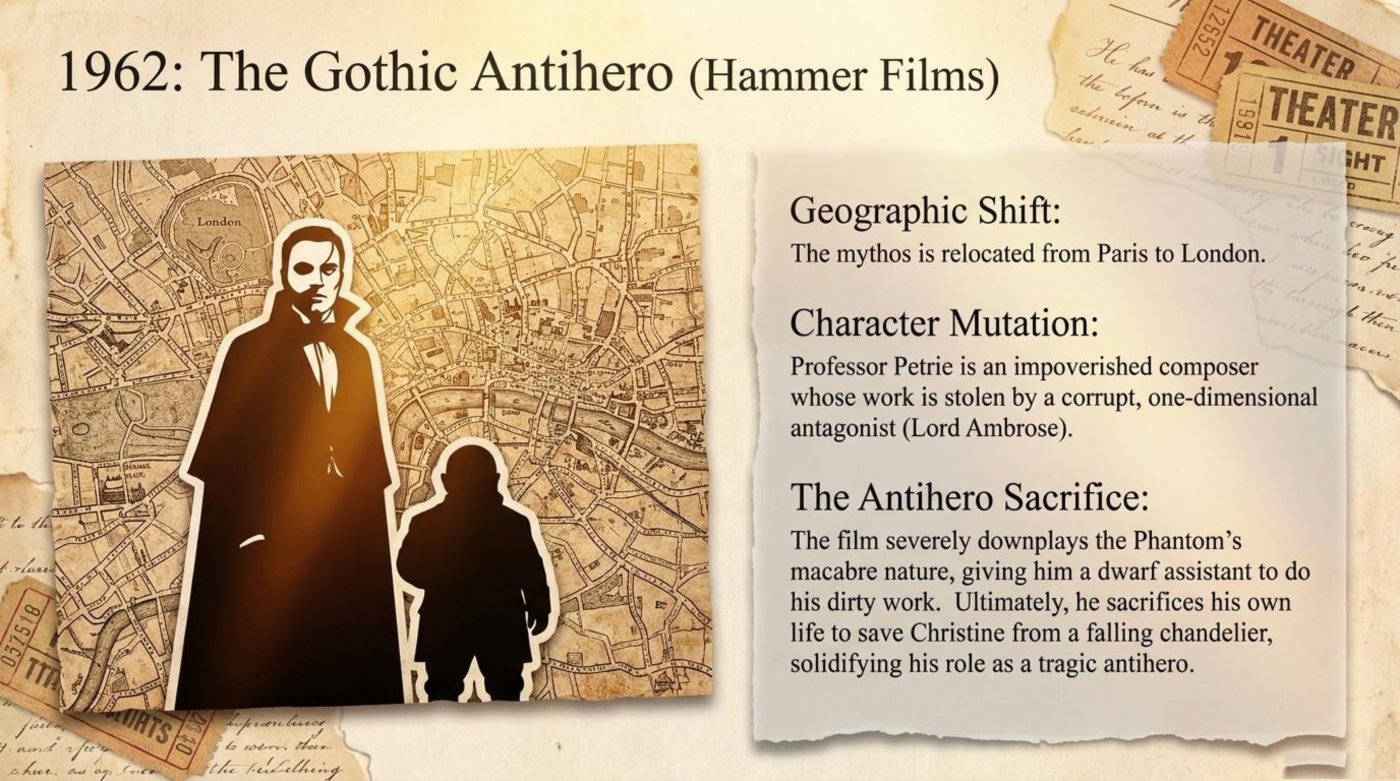
The third era moves the story across the Channel and softens its monster even further. The deck notes the relocation first:
“The mythos is relocated from Paris to London.”
Then it introduces a new Phantom with a grievance:
“Professor Petrie is an impoverished composer whose work is stolen by a corrupt, one-dimensional antagonist (Lord Ambrose).”
And finally it crowns him with a new title:
“The film severely downplays the Phantom’s macabre nature, giving him a dwarf assistant to do his dirty work. Ultimately, he sacrifices his own life to save Christine from a falling chandelier, solidifying his role as a tragic antihero.”
📌 Pay attention to the analytical vocabulary on this page: impoverished, corrupt, one-dimensional, downplay, macabre, solidify. These are the exact words used in serious film criticism, and mastering them instantly upgrades a learner’s reviews and essays.
🎟️ 1937 & 1989 · GLOBAL & SLASHER DEVIATIONS
Two Wild Departures
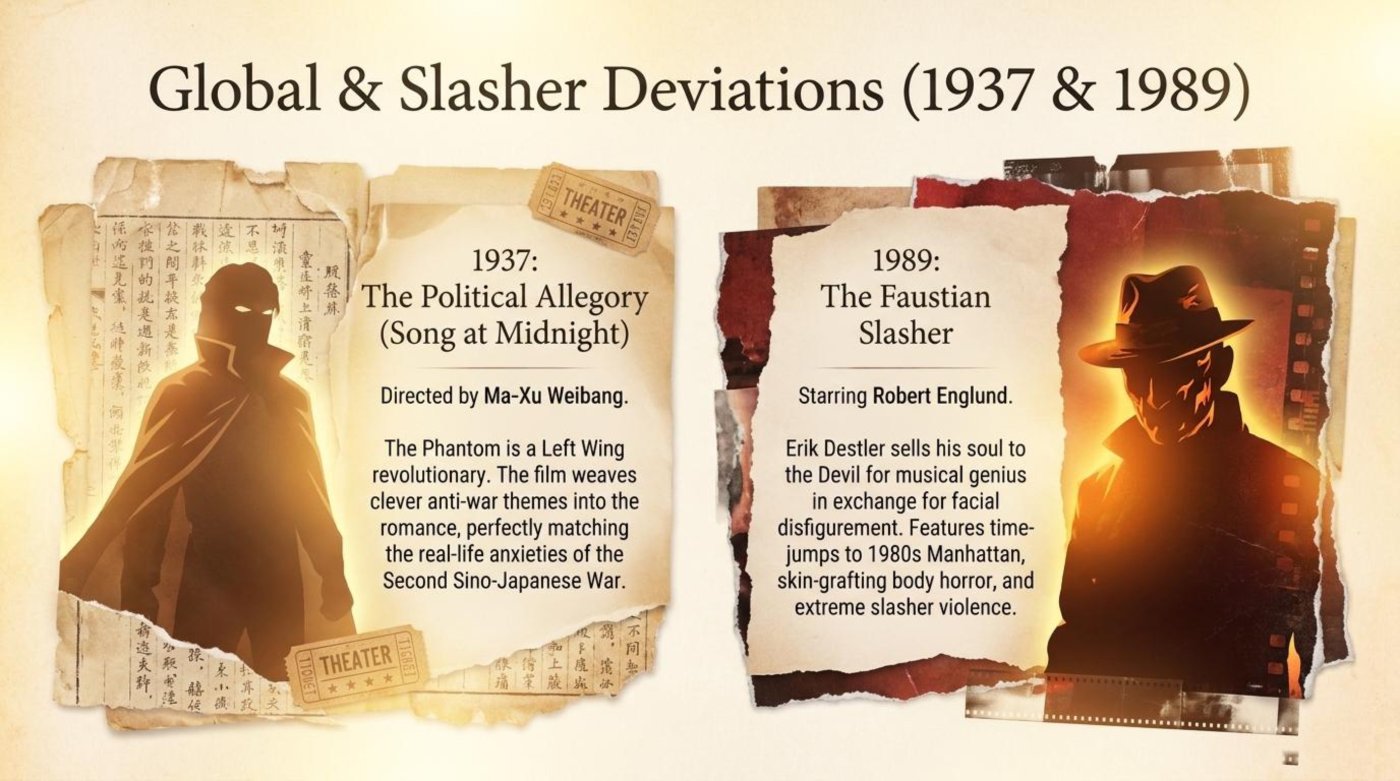
The deck widens the lens beyond Hollywood, and the contrast is striking. The Chinese adaptation of 1937 turns the Phantom into a political figure:
“Directed by Ma-Xu Weibang. The Phantom is a Left Wing revolutionary. The film weaves clever anti-war themes into the romance, perfectly matching the real-life anxieties of the Second Sino-Japanese War.”
The American version of 1989 travels in the opposite direction, into darkness:
“Starring Robert Englund. Erik Destler sells his soul to the Devil for musical genius in exchange for facial disfigurement. Features time-jumps to 1980s Manhattan, skin-grafting body horror, and extreme slasher violence.”
🎟️ 2004 · ROMANTIC SPECTACLE
The Mainstream Romantic Spectacle
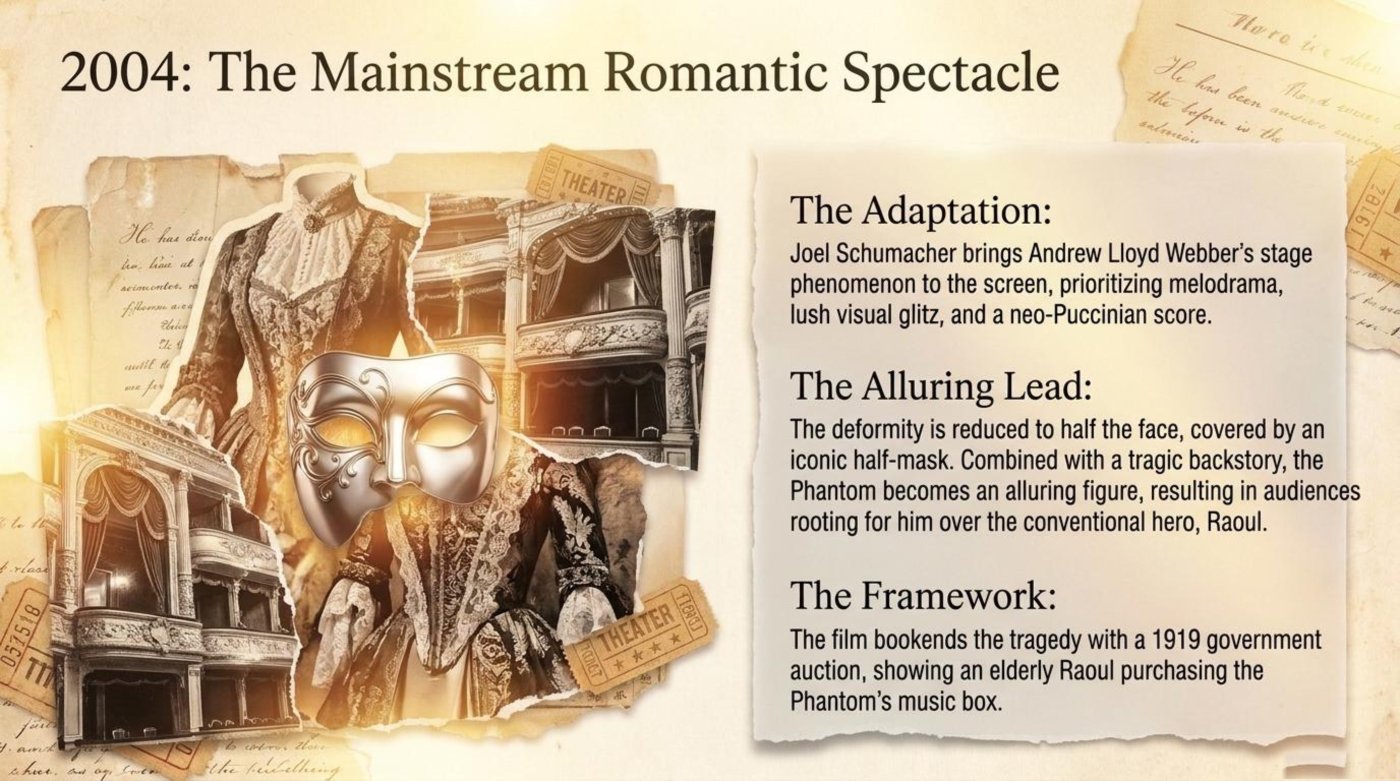
The final stop on the timeline brings the stage phenomenon to the screen:
“Joel Schumacher brings Andrew Lloyd Webber’s stage phenomenon to the screen, prioritizing melodrama, lush visual glitz, and a neo-Puccinian score.”
The monster has now become the romantic lead:
“The deformity is reduced to half the face, covered by an iconic half-mask. Combined with a tragic backstory, the Phantom becomes an alluring figure, resulting in audiences rooting for him over the conventional hero, Raoul.”
And the film frames its story with memory:
“The film bookends the tragedy with a 1919 government auction, showing an elderly Raoul purchasing the Phantom’s music box.”
The Taxonomy: One Character, Four Eras
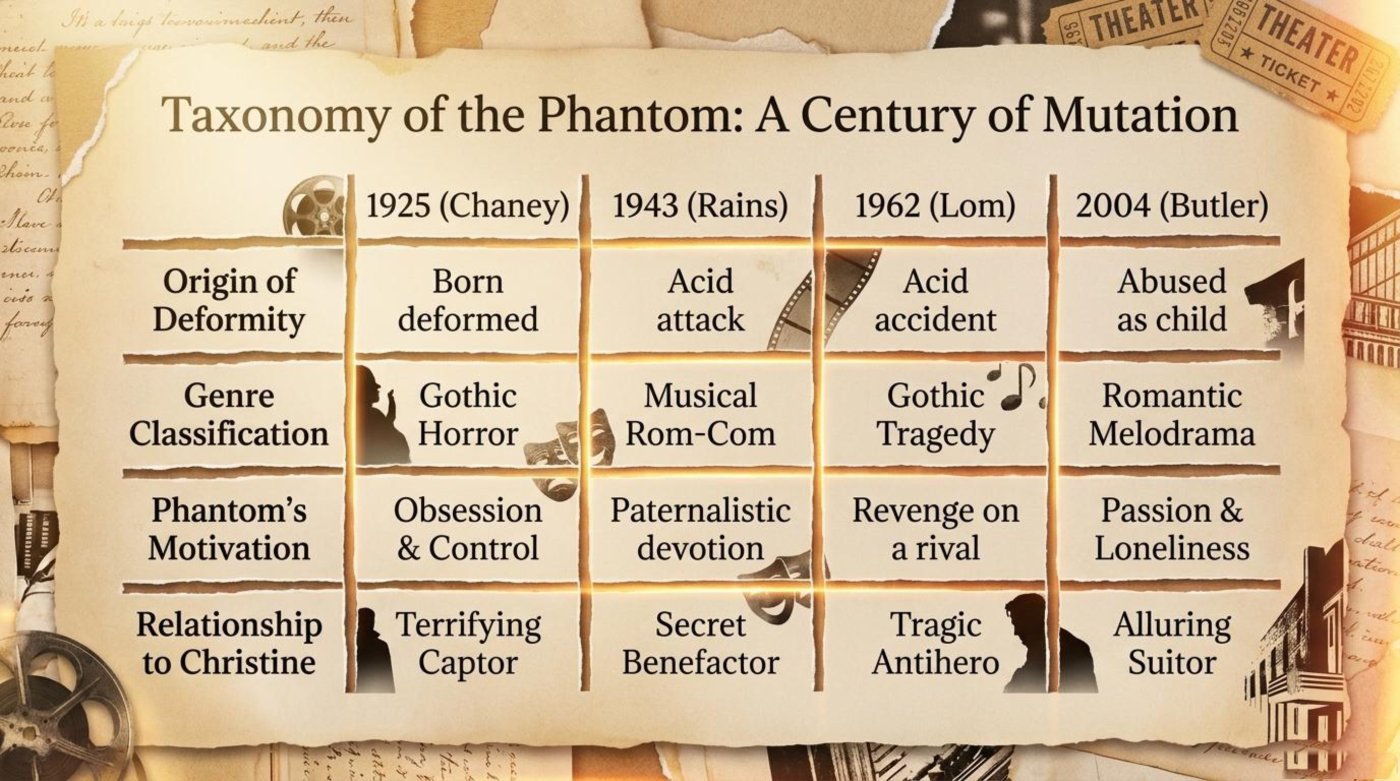
The deck then condenses the whole century into a single comparative map, and it is worth translating into prose. Across the four headline actors — Chaney (1925), Rains (1943), Lom (1962), and Butler (2004) — the origin of the deformity travels from “born deformed” to “acid attack,” then “acid accident,” and finally “abused as child.” The genre classification moves from gothic horror to musical rom-com, gothic tragedy, and romantic melodrama. The Phantom’s motivation evolves from obsession and control through paternalistic devotion and revenge on a rival to passion and loneliness. And his relationship to Christine transforms completely: from terrifying captor to secret benefactor, then tragic antihero, and at last alluring suitor.
Vocabulary and Language Takeaways
Nine words that tell the whole century
The deck is a dense forest of useful words, and the ones below repay careful study. Each entry follows the same path: the literal meaning, the figurative meaning, the way the material uses it, and the way the deck itself frames the idea. 👩🏫 Kelyn’s standing advice applies here: collect vocabulary from stories you love, because emotional memory makes words stick.
the source code
LITERAL MEANING: in computing, the original instructions from which a program is built.
FIGURATIVE MEANING: the original version of a story from which every later adaptation is constructed.
EXAMPLE FROM THE MATERIAL: “By emphasizing Christine’s innocence, Raoul’s heroism, or Erik’s pitiable past, the single source code can be fractured into a slasher film, a wartime feminist narrative, an anti-war allegory, or a global romantic spectacle.” The sentence treats filmmaking as software engineering: each movie is a new program compiled from the same original text.
HOW THE DECK FRAMES IT: the novel’s page is titled “The Source Code: Leroux’s 1910 Novel,” and three panels — The Framework, The Lovers, The Monster — break the book into components, exactly as a programmer studies code before rewriting it.
lineage
LITERAL MEANING: the line of descendants in a family tree.
FIGURATIVE MEANING: a chain of related works, each one a “descendant” of the previous one.
EXAMPLE FROM THE MATERIAL: the timeline page is titled “A Century of Mutation: The Cinematic Lineage” and connects “1925: Silent Horror,” “1943: Technicolor Tragedy,” “1962: Hammer Gothic Antihero,” “1989: Faustian Slasher,” and “2004: Romantic Spectacle.”
HOW THE DECK FRAMES IT: the film-strip graphic visually presents the movies as relatives descending from one ancestor — the 1910 novel — which turns film history into a family history.
fidelity (to something)
LITERAL MEANING: faithfulness or loyalty to a person, a promise, or a belief.
FIGURATIVE MEANING: the degree to which an adaptation stays close to its source.
EXAMPLE FROM THE MATERIAL: “Fidelity to Horror: Retains Leroux’s vision of a man deformed from birth, relying on gothic atmosphere and pure terror.” Here “retains” is the act of fidelity itself: the 1925 film refuses to soften the novel’s darkest idea.
HOW THE DECK FRAMES IT: fidelity works as a measuring stick across the whole presentation, and later pages measure how each era bends that loyalty toward comedy, revenge, or romance.
unmasking
LITERAL MEANING: the act of removing someone’s mask.
FIGURATIVE MEANING: the dramatic revelation of a hidden truth or identity.
EXAMPLE FROM THE MATERIAL: “The Unmasking: The reveal was so shocking that 1925 theater patrons reportedly screamed and fainted.”
HOW THE DECK FRAMES IT: by capitalizing “The Unmasking” as a headline, the deck treats the moment as the film’s central event — the instant when disguise ends and truth begins, both on screen and in the story.
a Faustian bargain (Faustian)
LITERAL MEANING: connected to Faust, the legendary scholar who sold his soul to the Devil in exchange for knowledge and power.
FIGURATIVE MEANING: any deal that trades something essential and irreplaceable for talent, fame, or success.
EXAMPLE FROM THE MATERIAL: “Erik Destler sells his soul to the Devil for musical genius in exchange for facial disfigurement.”
HOW THE DECK FRAMES IT: by labeling the 1989 film “The Faustian Slasher,” the deck compresses an entire plot into one literary adjective and trusts the reader to feel the terrible price of the deal instantly.
antihero
LITERAL MEANING: a central character who lacks classic heroic virtues.
FIGURATIVE MEANING: a flawed, even dark protagonist whom the audience supports anyway.
EXAMPLE FROM THE MATERIAL: “Ultimately, he sacrifices his own life to save Christine from a falling chandelier, solidifying his role as a tragic antihero.”
HOW THE DECK FRAMES IT: the deck builds a full arc for the word: the 1962 Phantom’s “macabre nature” is downplayed until he dies a savior, and the final map crowns the 2004 Phantom “Alluring Suitor” — a character type suspended between villain and lover.
malleable
LITERAL MEANING: (of metal or clay) easy to hammer or press into new shapes.
FIGURATIVE MEANING: flexible; able to be reshaped for new purposes and new audiences.
EXAMPLE FROM THE MATERIAL: “The Phantom survives precisely because he is a malleable archetype. Filmmakers continually alter the love triangle to fit the anxieties and desires of their specific era.”
HOW THE DECK FRAMES IT: the deck makes malleability the secret of immortality: a rigid character belongs to one decade, while a malleable one can be recast for every generation.
to bookend
LITERAL MEANING: a bookend is the heavy object that holds a row of books upright at each end of a shelf.
FIGURATIVE MEANING: to frame a story with matching opening and closing scenes.
EXAMPLE FROM THE MATERIAL: “The film bookends the tragedy with a 1919 government auction, showing an elderly Raoul purchasing the Phantom’s music box.”
HOW THE DECK FRAMES IT: the verb turns a household noun into a filmmaking term: the auction at the start and the end brackets the whole tragedy like two bookends on a shelf.
alluring
LITERAL MEANING: strongly attractive, almost magnetic.
FIGURATIVE MEANING: charming in a slightly dangerous, mysterious way.
EXAMPLE FROM THE MATERIAL: “The deformity is reduced to half the face, covered by an iconic half-mask. Combined with a tragic backstory, the Phantom becomes an alluring figure, resulting in audiences rooting for him over the conventional hero, Raoul.”
HOW THE DECK FRAMES IT: one of the final panels is titled “The Alluring Lead,” signaling that by the twenty-first century attraction — not terror — has become the character’s engine.
📌 Notice how these nine words form a network around one theme: transformation. A source code produces a lineage; fidelity weakens into an unmasking; a monster becomes an antihero through a Faustian deal; and because the archetype is malleable, every era can bookend the tale around an alluring new Phantom. Learning words in connected clusters like this is far more effective than memorizing isolated lists.
Metaphors and Symbols
The deeper meaning beneath the mask
🎭 Symbol One — The Prism
The most elegant image in the deck is scientific rather than theatrical: Leroux’s novel is drawn as a beam of white light passing through a glass prism and splitting into five colored rays labeled Horror, Tragedy, Melodrama, Romance, and Political Allegory. The deck states the insight plainly:
“The Phantom survives precisely because he is a malleable archetype. Filmmakers continually alter the love triangle to fit the anxieties and desires of their specific era.”
And it completes the picture with the spectrum:
“By emphasizing Christine’s innocence, Raoul’s heroism, or Erik’s pitiable past, the single source code can be fractured into a slasher film, a wartime feminist narrative, an anti-war allegory, or a global romantic spectacle.”
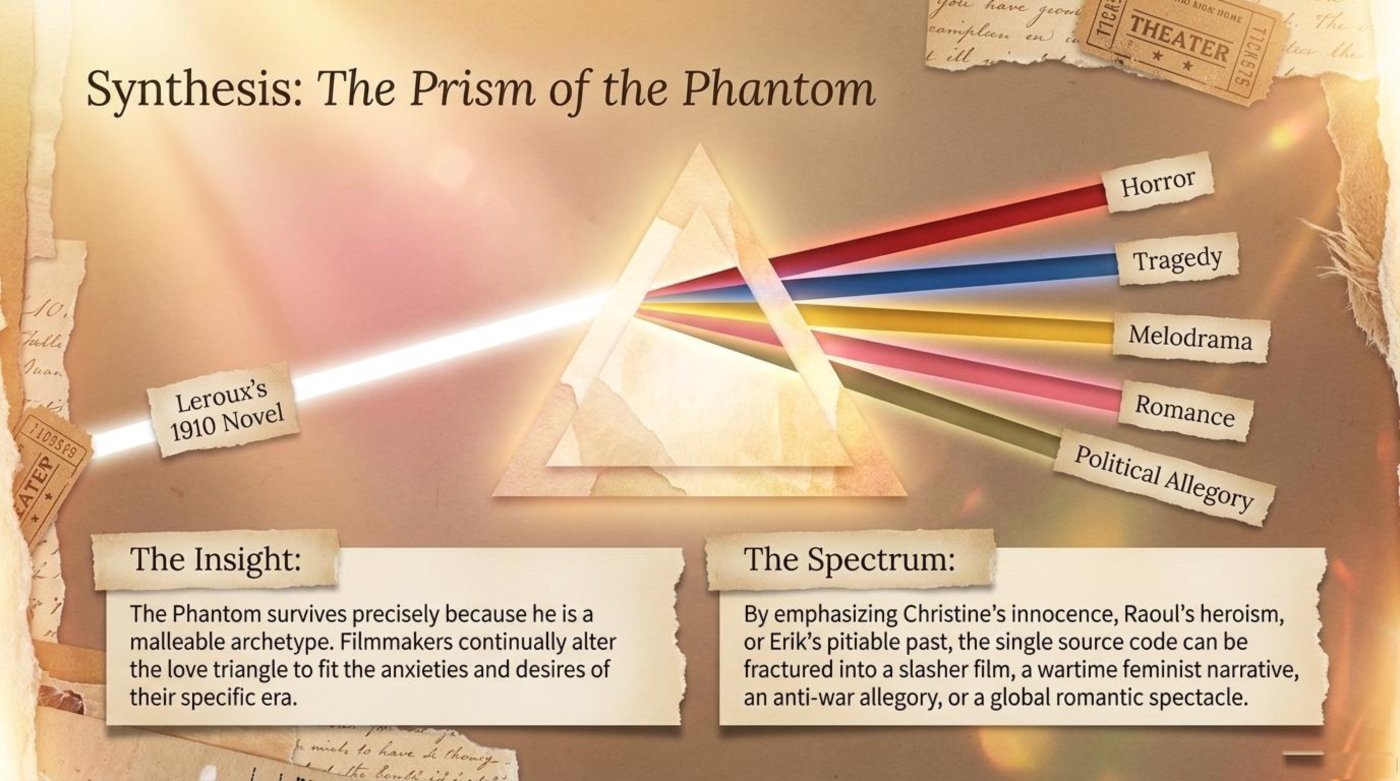
The metaphor explains why the character never dies. A single genre pins a story to one decade, but a prism of possibilities lets every generation find its own wavelength. For language learners, the lesson transfers directly: one authentic text can be studied through many frequencies too — vocabulary one day, grammar the next, culture and history after that.
🕯️ Symbol Two — The Chandelier Paradigm
The falling chandelier is the story’s most famous prop, and the deck turns it into a barometer of each era’s emotions. In 1925 it is an instrument of slaughter:
“1925: An Act of Pure Terror. The chandelier is dropped deliberately onto the audience to cause maximum casualties, cementing the Phantom as a remorseless monster.”
In 1943 it becomes a mere trick:
“1943: A Diversionary Tactic. Dropped to cause chaos and confusion during a performance of a Russian opera, serving primarily as a distraction so the Phantom can kidnap Christine.”
And in 2004 it is a scream of the heart:
“2004: Explosive Passionate Revenge. Pushed to the end of the film (altered from the stage play due to time constraints), it serves as the ultimate fiery punctuation to the Phantom’s emotional devastation and defeat.”
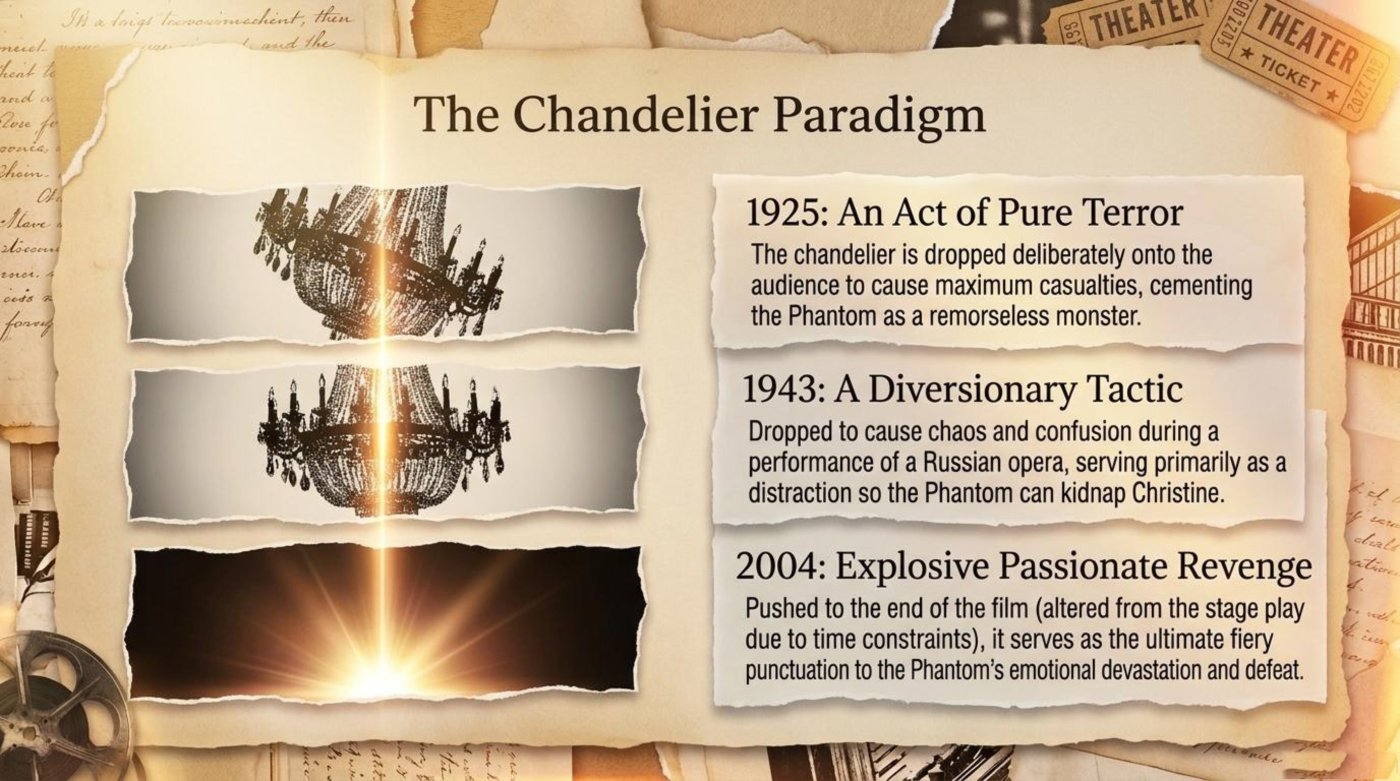
There is a quiet fourth variation hidden in the 1962 chapter, where the same object turns from weapon into shield: the Phantom “sacrifices his own life to save Christine from a falling chandelier.” A single prop thus measures exactly how much fear and how much sympathy each audience is willing to feel for the same man.
🎭 Symbol Three — The Mask
The mask is the character’s soul made visible, and each era draws the line between monster and man in a different place. In 1925 the mask hides a full-face horror so extreme that its removal made audiences “scream and faint.” By 2004 the deformity “is reduced to half the face, covered by an iconic half-mask,” and the hidden half has become glamorous rather than grotesque. The mask, in other words, is a dial that filmmakers adjust: the more elegant the mask, the more human the Phantom underneath, and the more willingly the audience falls in love with him. It also works as a universal metaphor — every person presents a polished surface to the world, and every unmasking is a moment of vulnerability and truth.
💾 Symbol Four — The Source Code Itself
Finally, the deck’s central metaphor — the novel as source code — deserves its own recognition. It reframes authorship: Leroux did not write one story but wrote a program that others would run, modify, and recompile forever. The 1937 revolutionary, the 1943 violinist, the 1962 professor, and the 2004 romantic lead are all outputs of the same code with different parameters. For learners, the parallel is encouraging: your first clumsy draft, your hesitant summary, your notes from one lesson — these are source code too, waiting to be recompiled into an email, an essay, or a toast at a wedding.
The Enduring Spirit of Music
Inside our minds
The deck closes not with an ending but with a promise, and the words deserve to be read slowly:
“For over a century, the Opera Ghost has evolved from a terrifying creature of the dark into a timeless symbol of tragic romance. As long as there is an audience to listen, the Phantom of the Opera will always be there — inside our minds.”
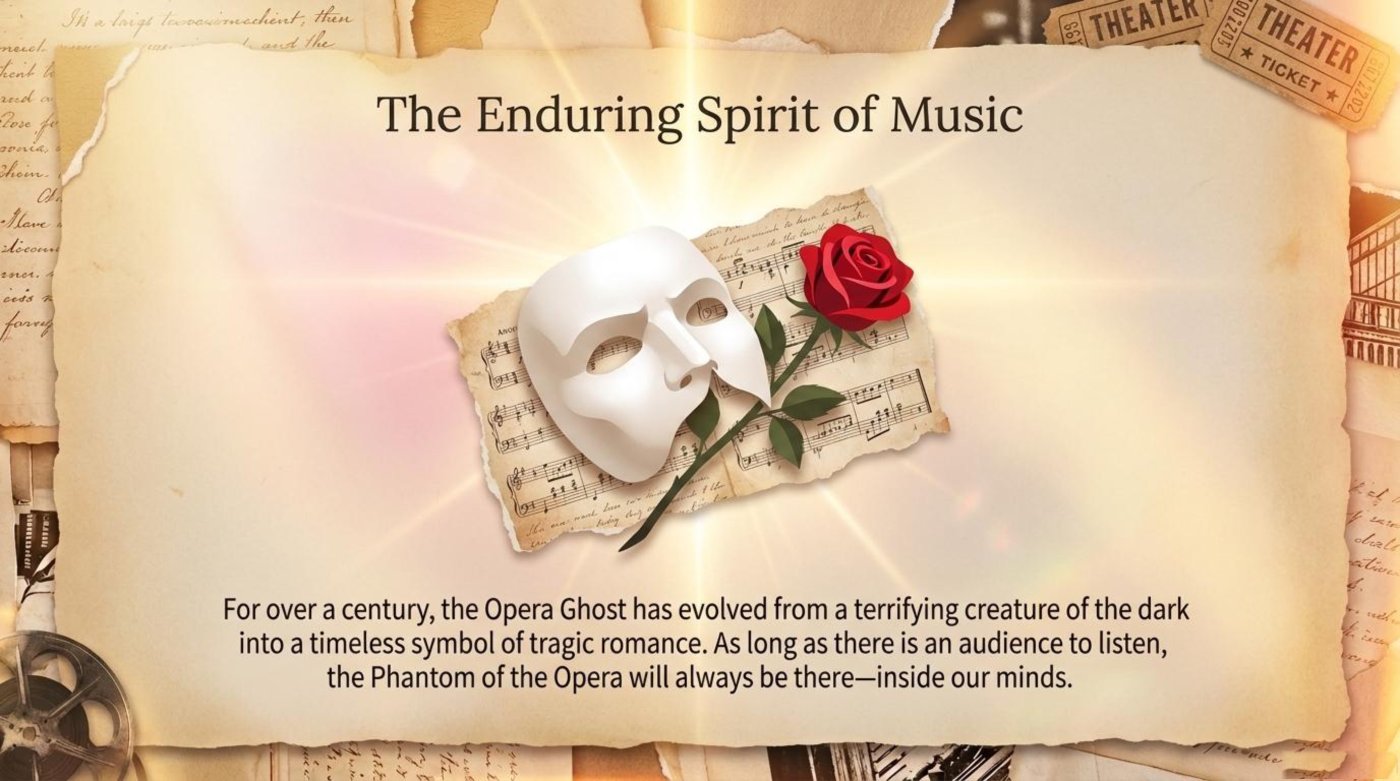
The main takeaway for language learners hides inside that final line. Stories survive because someone keeps retelling them, and a language survives for exactly the same reason. Every learner who retells the Phantom’s century in their own words — five sentences, one for each era, from silent horror to romantic spectacle — becomes part of the same lineage. 👩🏫 Kelyn closed the lesson with precisely that challenge, reminding the class that a story you can retell is a story you own, and vocabulary you can retell is vocabulary you keep.
🎯 Your Turn — Practice Makes the Phantom
Task 1 — Gap fill. Complete each sentence with a word from Act II: malleable, lineage, alluring, bookends, fidelity, unmasking.
- The 1925 film shows great to Leroux’s dark vision.
- The final line of the deck the story with memory and music.
- By 2004 the Phantom had become an figure whom audiences support.
- The character survives because he is a archetype.
- All the films together form a single cinematic .
- The famous made 1925 audiences scream and faint.
🗝️ SHOW THE ANSWERS
1 — fidelity · 2 — bookends · 3 — alluring · 4 — malleable · 5 — lineage · 6 — unmasking
Task 2 — Retelling. Retell the century of the Phantom in five sentences, one for each era from silent horror to romantic spectacle, using this pattern: “In 1925 he was born deformed, but by 2004 he had become an alluring suitor.”
Task 3 — Symbol hunt. Choose one symbol — the mask, the chandelier, or the prism — and write a short paragraph about what it means in your own life.
- 📄 The full presentation — phantom-opera.pdf
- 📄 The lesson summary — summary-20260901165730W6Fsqh.pdf

No comments:
Post a Comment