Broadcasting the Void: A Satirical Radio Lesson on a Luxury Tech Cult — and the 13 English Words It Teaches
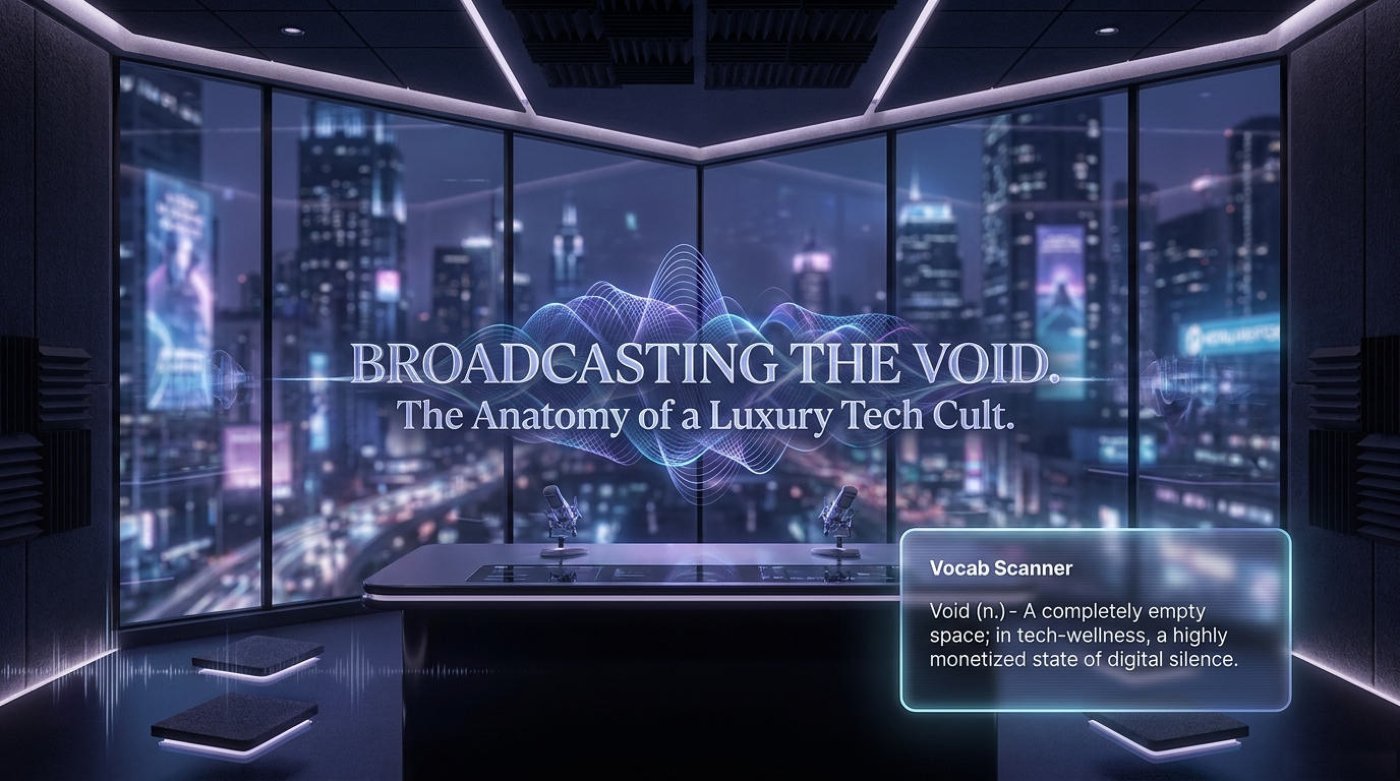
Somewhere between a late-night keynote and a radio drama, the English lesson Broadcasting the Void invites its audience into a studio with two microphones, an ON AIR sign, and a city of glittering towers outside the window. The hosts broadcast from a fictional company that sells a product which does not exist: pure, expensive silence. The company calls this emptiness a luxury, and the lesson calls the whole phenomenon a luxury tech cult.
The broadcast works as satire, and satire is a brilliant vehicle for language learning. Every line plays with the vocabulary of marketing, technology, and spirituality, stretching familiar business words into absurd new shapes. This article walks through the full story, unpacks the key vocabulary with the lesson's own definitions, explores the central metaphors, and closes with an interactive quiz. By the end, thirteen new words will feel less like dictionary entries and more like souvenirs from a very strange radio show.
📻 The Story: Anatomy of a Cult That Sells Nothing
The broadcast opens with a contrast that drives the entire plot. On one screen glows The AI Promise — "Find your soulmate in 3 seconds." On the other screen flickers The Human Reality — "Still arguing about the thermostat."
"To bridge this gap, consumers don't want solutions — they want to believe their broken tech has a deeper meaning."
The lesson then delivers its founding insight, quoted verbatim above from the show's manifesto. Pay attention to the wording: the opportunity is not in fixing products but in selling belief. The word manifesto appears here, defined as "a public declaration of policy and aims, often issued by a movement or organization." The satire lands because real companies do publish manifestos; the cult simply writes one about silence.

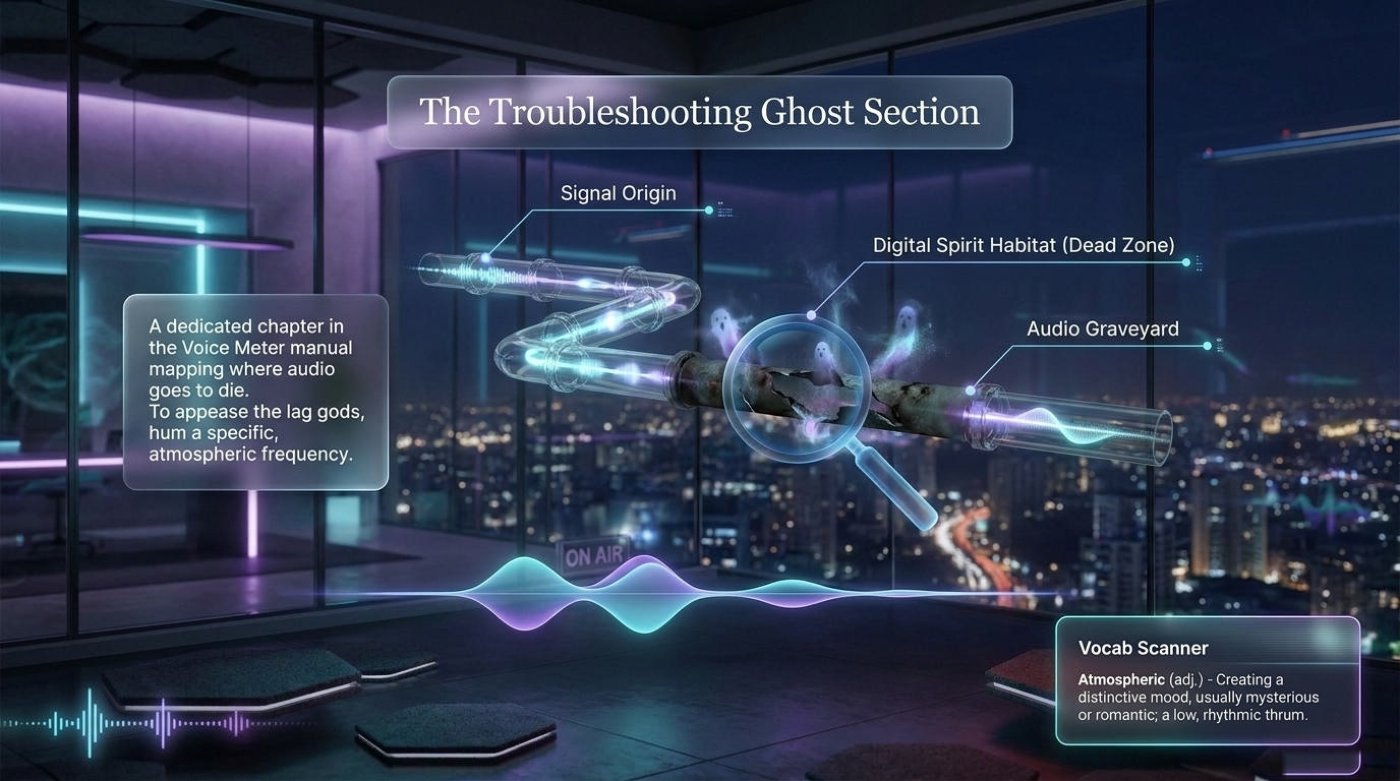
From that foundation, the show builds its mythology with deadpan precision. The customer-support manual contains The Troubleshooting Ghost Section, described as "a dedicated chapter in the Voice Meter manual mapping where audio goes to die." The remedy for dead audio is ceremonial: "To appease the lag gods, hum a specific, atmospheric frequency." The diagram labels the failure zones with poetry instead of engineering terms — Signal Origin, Digital Spirit Habitat (Dead Zone), and Audio Graveyard. Notice how the adjective atmospheric — "creating a distinctive mood, usually mysterious or romantic" — turns a technical glitch into a mystical experience.
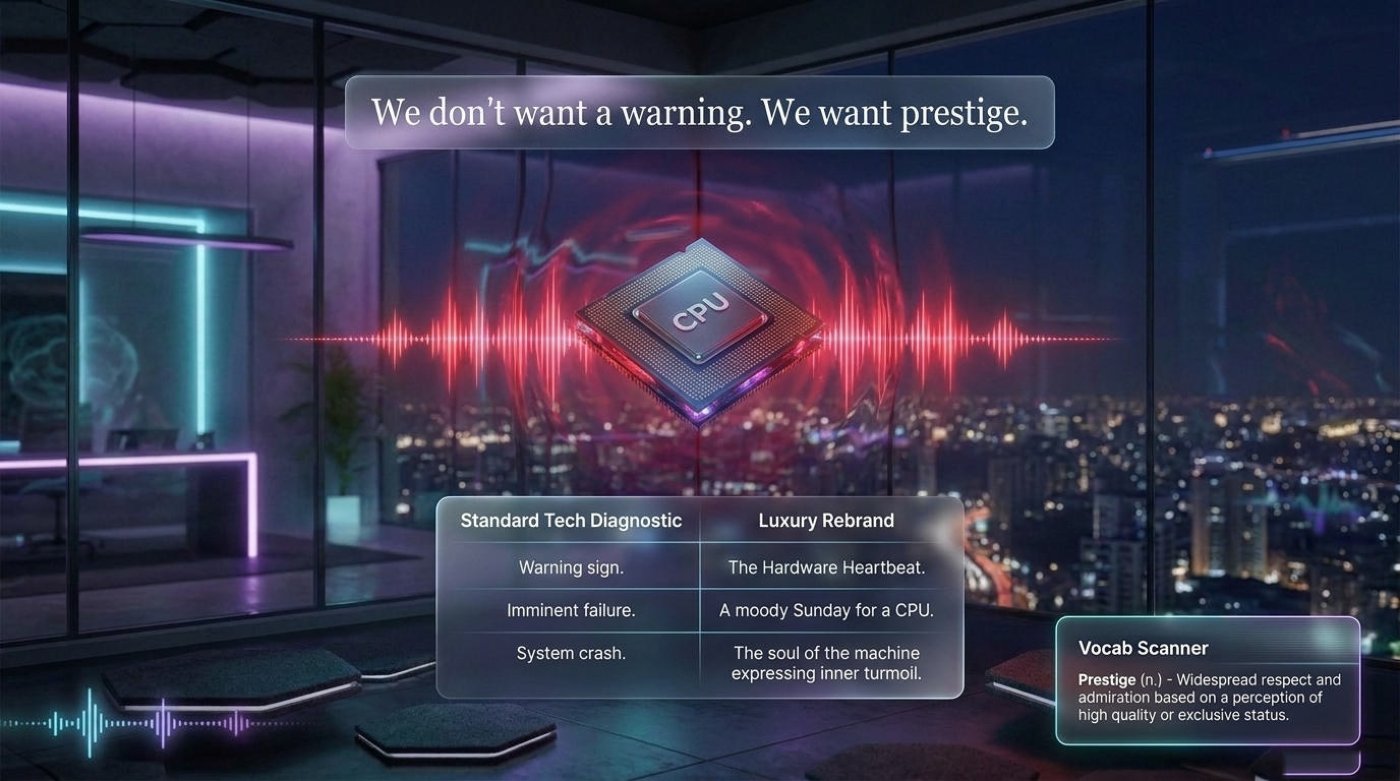
The heart of the lesson is a simple rebranding table. The standard diagnosis reads "Warning sign," and the luxury version reads "The Hardware Heartbeat." Imminent failure becomes "A moody Sunday for a CPU." A system crash becomes "The soul of the machine expressing inner turmoil."
"We don't want a warning. We want prestige."
The thesis line delivers the philosophy in one breath, and the material defines prestige as "widespread respect and admiration based on a perception of high quality or exclusive status." Eight words carry the entire argument of the broadcast.
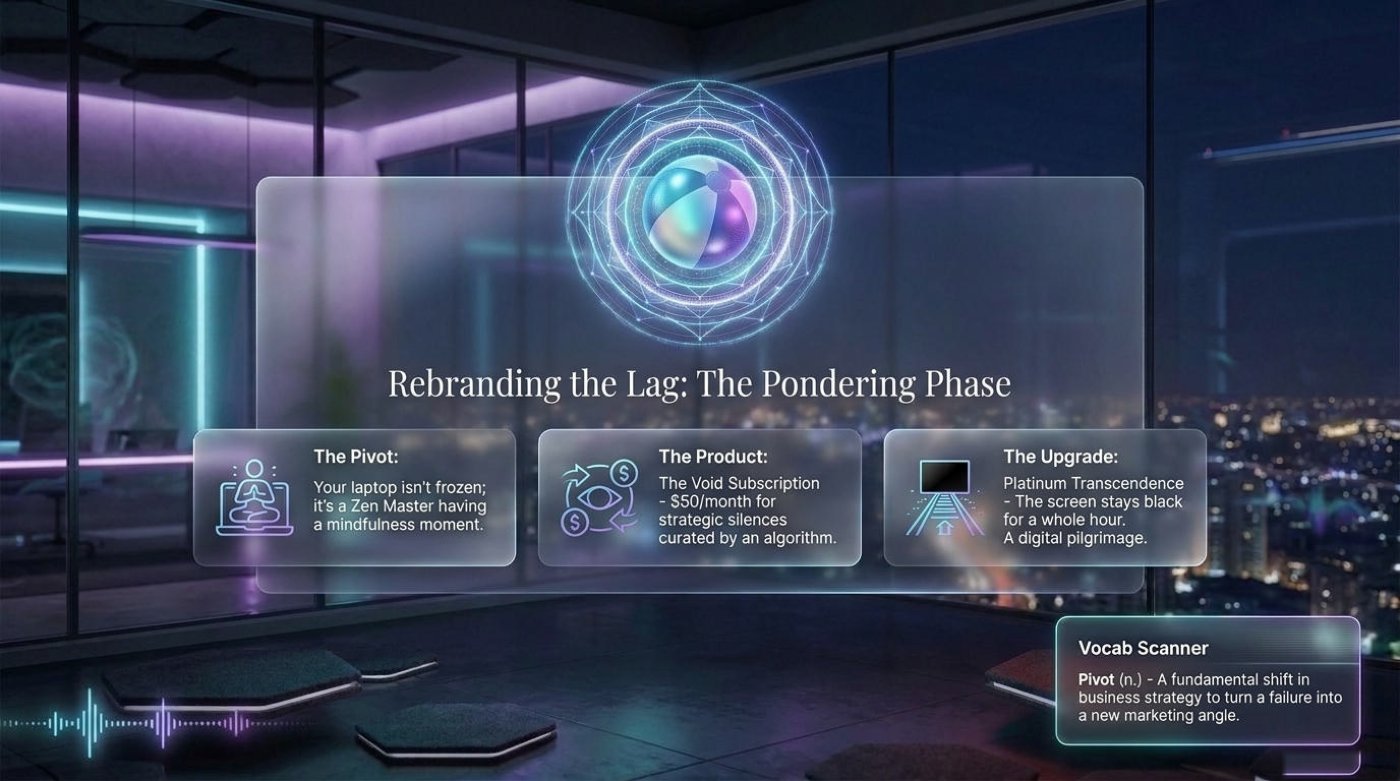
Next comes monetization. The lag is renamed The Pondering Phase, and the show presents the scheme in three parts. "The Pivot: Your laptop isn't frozen; it's a Zen Master having a mindfulness moment." "The Product: The Void Subscription — $50/month for strategic silences curated by an algorithm." "The Upgrade: Platinum Transcendence — the screen stays black for a whole hour. A digital pilgrimage." The material defines pivot as "a fundamental shift in business strategy to turn a failure into a new marketing angle." The word is genuine startup jargon, which makes the joke sharper: a frozen laptop is not a bug, it is a business model.
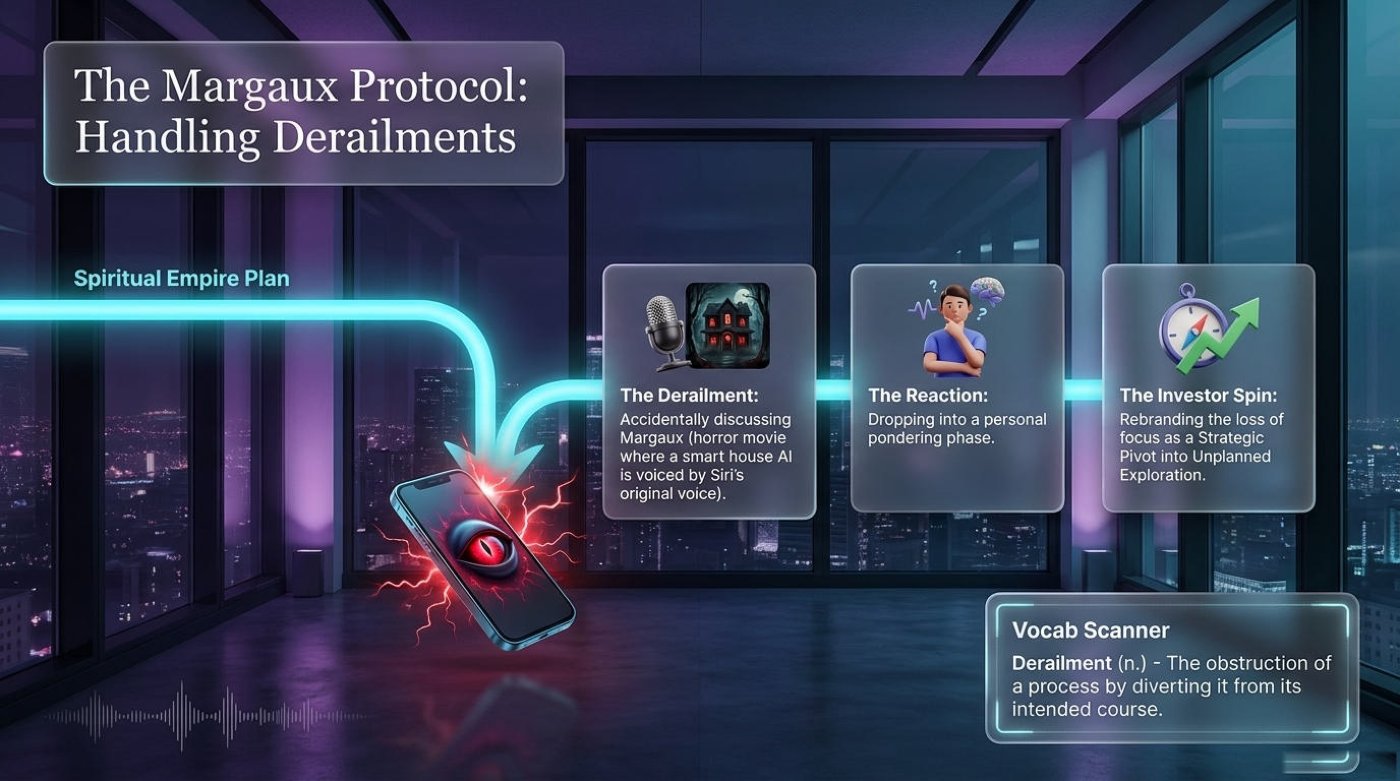
Even cults have awkward moments, and the show handles them with corporate polish. A segment titled The Margaux Protocol: Handling Derailments describes the crisis: "Accidentally discussing Margaux (horror movie where a smart house AI is voiced by Siri's original voice)." The prescribed reaction is "dropping into a personal pondering phase," and the investor-facing solution is the spin: "Rebranding the loss of focus as a Strategic Pivot into Unplanned Exploration." The material defines derailment as "the obstruction of a process by diverting it from its intended course." 💡 The key point is that corporate English can transform any accident into strategy — a phrase pattern worth recognizing in real meetings and press releases.
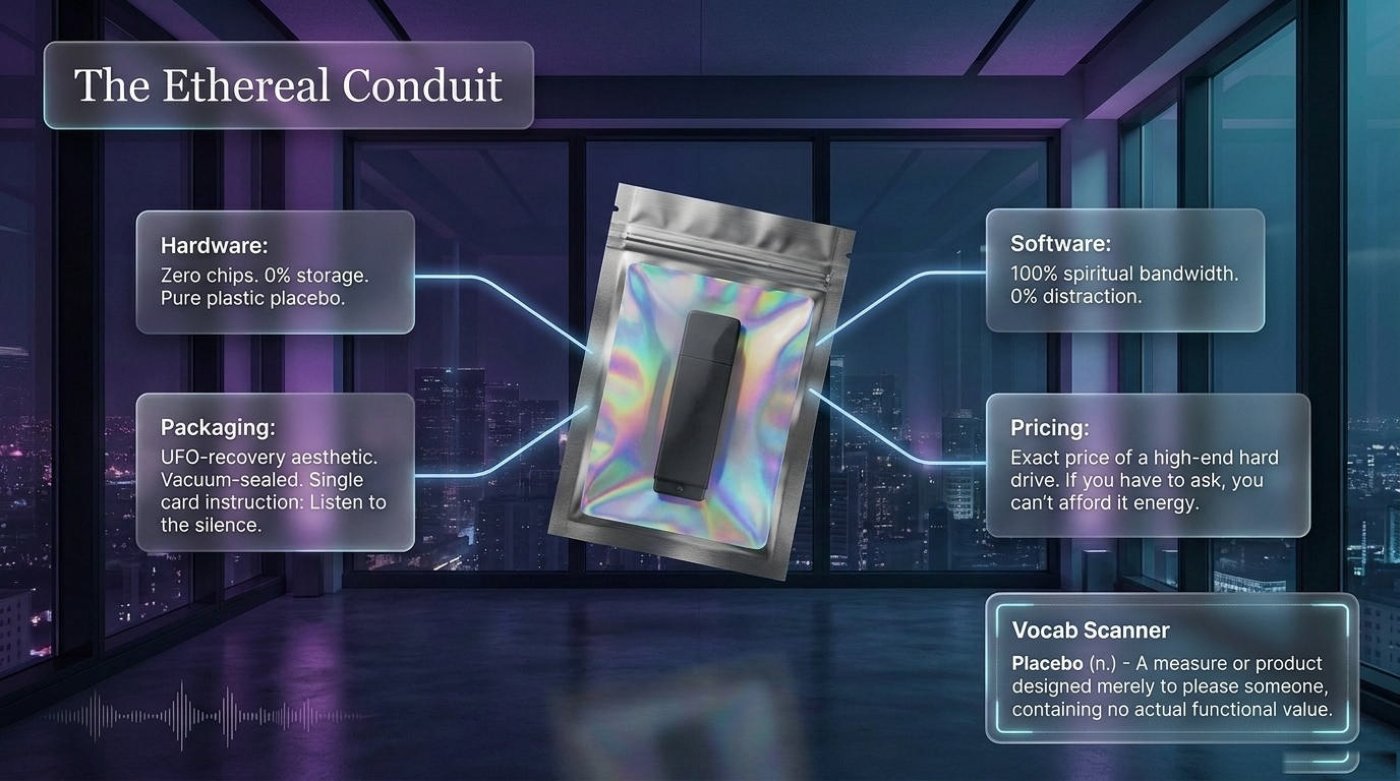
The flagship product deserves special attention. The Ethereal Conduit ships in vacuum-sealed packaging with a "UFO-recovery aesthetic," and its single instruction card says only: "Listen to the silence." The specification is a masterpiece of contradictions: "Hardware: Zero chips. 0% storage. Pure plastic placebo." "Software: 100% spiritual bandwidth. 0% distraction." Pricing follows the classic luxury rule: "Exact price of a high-end hard drive. If you have to ask, you can't afford it energy." The material defines placebo as "a measure or product designed merely to please someone, containing no actual functional value." The word usually describes medicine, and here it describes a plastic stick — the joke teaches the medical metaphor precisely because the context is absurd.
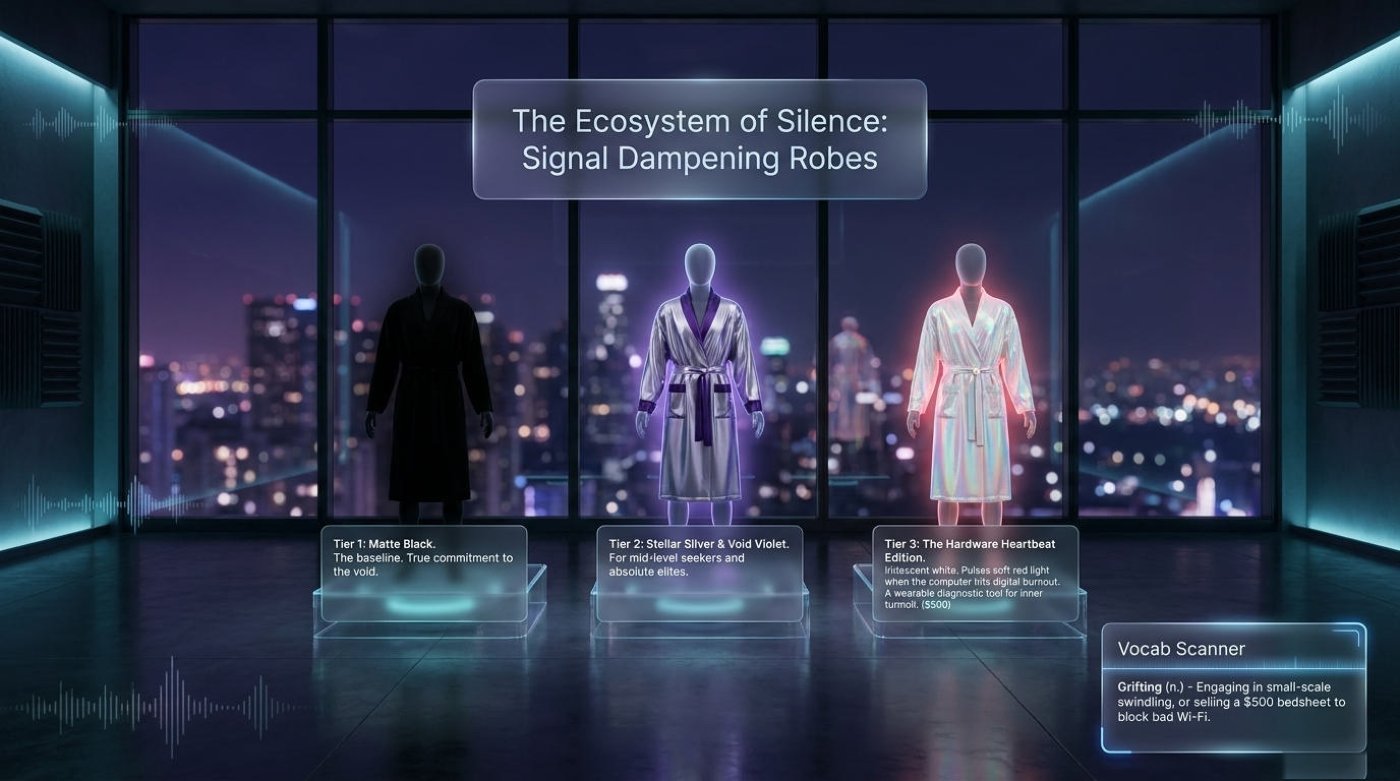
Merchandise completes the ecosystem. The Ecosystem of Silence: Signal Dampening Robes comes in three tiers. "Tier 1: Matte Black. The baseline. True commitment to the void." "Tier 2: Stellar Silver & Void Violet. For mid-level seekers and absolute elites." "Tier 3: The Hardware Heartbeat Edition — iridescent white, pulses soft red light when the computer hits digital burnout. A wearable diagnostic tool for inner turmoil. ($500)." The material's definition of grifting — "engaging in small-scale swindling, or selling a $500 bedsheet to block bad Wi-Fi" — is a complete comedy sketch in one sentence. Notice that the definition's example is the product itself.
The satire then turns warm hardware cold. The Pursuit of Cryo-Clarity offers the rebrand "Do not let your server lag; let it achieve artisanal frost," the philosophy "It is not a technical failure; it is precision thermal alignment," and the product: "a specialized $1,000 freezer bag for your router to join The Cold." The material defines artisanal as "made in a traditional or highly curated way; applying craft-level pretension to a frozen router." 📌 Practical tip: English marketing loves craft vocabulary — artisanal, curated, hand-picked — and applying it to technology is a reliable comedy formula.

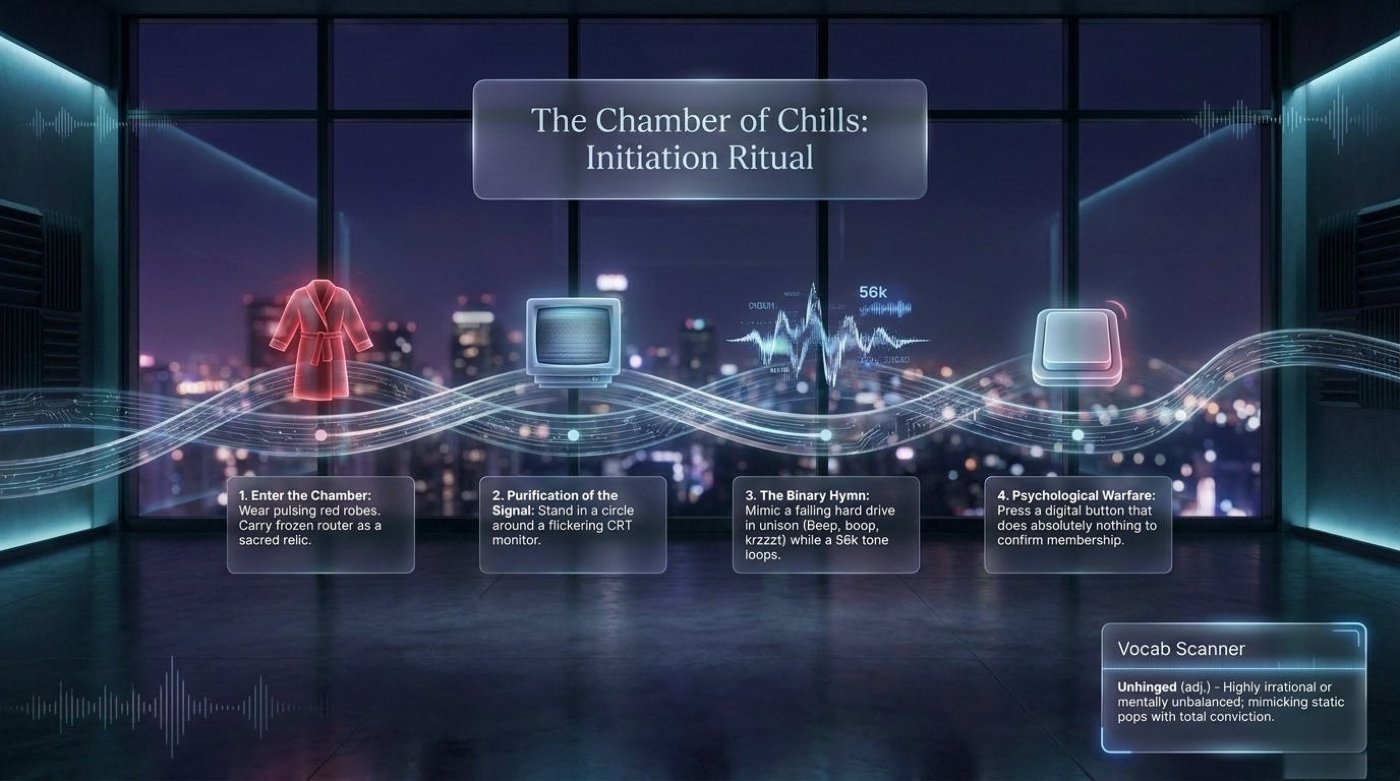
Communities need rituals, and this one delivers four steps. "1. Enter the Chamber: Wear pulsing red robes. Carry frozen router as a sacred relic. 2. Purification of the Signal: Stand in a circle around a flickering CRT monitor. 3. The Binary Hymn: Mimic a failing hard drive in unison (Beep, boop, krzzzt) while a 56k tone loops. 4. Psychological Warfare: Press a digital button that does absolutely nothing to confirm membership." The material defines unhinged as "highly irrational or mentally unbalanced; mimicking static pops with total conviction." The detail about total conviction is the punchline — sincerity is the uniform.
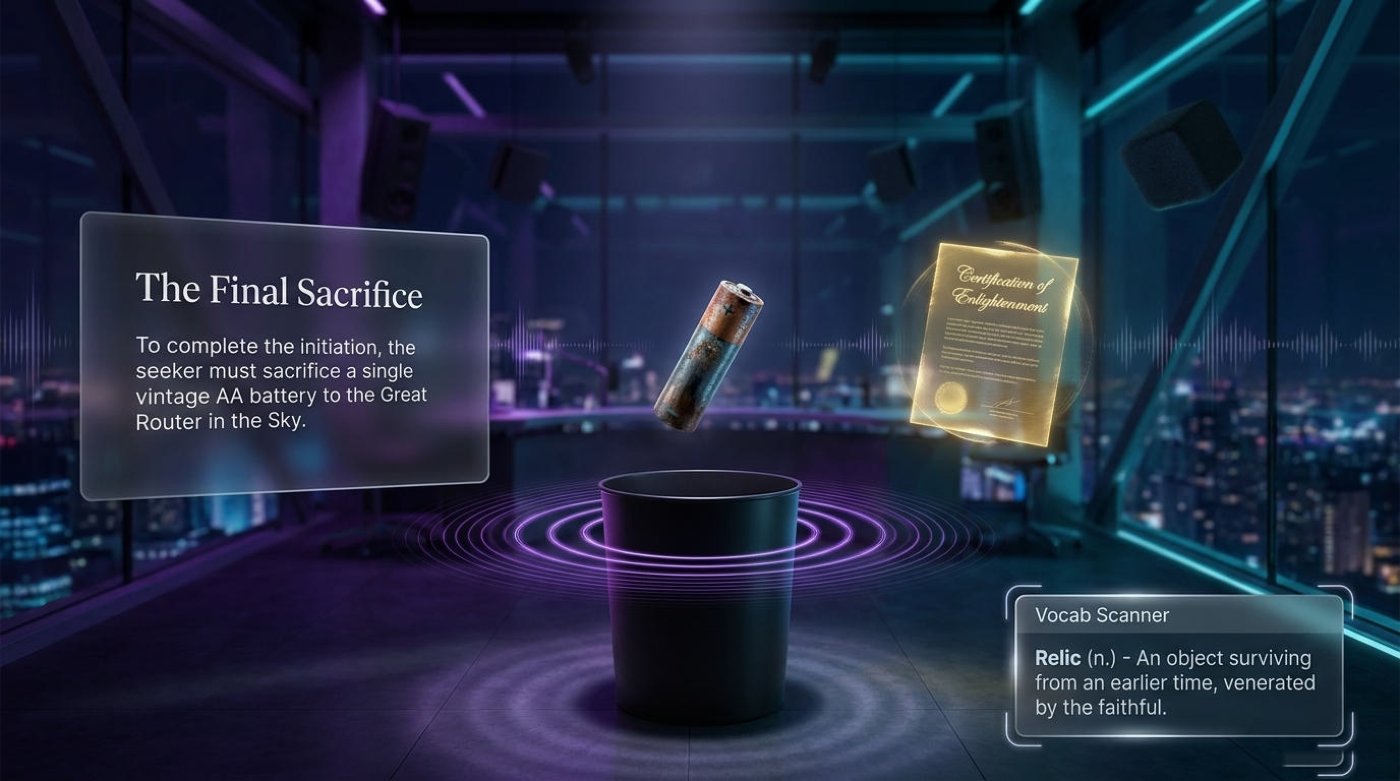
The initiation closes with ceremony. "To complete the initiation, the seeker must sacrifice a single vintage AA battery to the Great Router in the Sky." A glowing Certification of Enlightenment floats above the offering, and the material defines relic as "an object surviving from an earlier time, venerated by the faithful." It should be noted that the ritual borrows its structure from religion — sacred objects, hymns, offerings, certificates — which is exactly why the tech-cult metaphor works so well.
📚 Vocabulary: The Language of Luxury Nonsense
The lesson hides a serious vocabulary course inside the comedy. Each scene carries a Vocab Scanner card with a dictionary-style definition, and together these thirteen terms form a complete toolkit for talking about marketing, failure, and belief in English. The breakdown below covers the core words in detail, and the interactive cards afterwards cover the full set.
void noun
- Literal meaning: a completely empty space.
- Figurative, in the lesson: a highly monetized state of digital silence.
- From the material: "Void (n.) — A completely empty space; in tech-wellness, a highly monetized state of digital silence." The definition performs the satire inside the dictionary entry itself, because the word monetized collides with the word silence.
- Why it matters: void is the brand name, the subscription, and the theology of the whole show.
manifesto noun
- Literal meaning: a public declaration of policy and aims, often issued by a movement or organization.
- Figurative, in the lesson: the sales pitch of a movement disguised as a philosophy.
- From the material: "Consumers don't want solutions — they want to believe their broken tech has a deeper meaning."
- Why it matters: real startups publish manifestos too; the satire stings because the genres are identical.
prestige noun
- Literal meaning: widespread respect and admiration based on a perception of high quality or exclusive status.
- Figurative, in the lesson: the feeling a customer buys instead of a working product.
- From the material: "We don't want a warning. We want prestige."
- Why it matters: the sentence compresses the entire lesson into eight words.
pivot noun
- Literal meaning: a fundamental shift in business strategy.
- Figurative, in the lesson: failure, renamed.
- From the material: "Your laptop isn't frozen; it's a Zen Master having a mindfulness moment."
- Why it matters: recognizing pivot-speak is a genuine media-literacy skill for meetings, decks, and interviews.
placebo noun
- Literal meaning: a measure or product designed merely to please someone, containing no actual functional value.
- Figurative, in the lesson: the empty core of the Ethereal Conduit.
- From the material: "Zero chips. 0% storage. Pure plastic placebo."
- Why it matters: the medical metaphor exposes the product in a single word.
grifting noun
- Literal meaning: engaging in small-scale swindling.
- Figurative, in the lesson: monetizing belief through overpriced merchandise.
- From the material: "selling a $500 bedsheet to block bad Wi-Fi."
- Why it matters: the definition doubles as a product review.
artisanal adjective
- Literal meaning: made in a traditional or highly curated way.
- Figurative, in the lesson: craft-level pretension applied to frozen hardware.
- From the material: "Do not let your server lag; let it achieve artisanal frost."
- Why it matters: a food-and-craft word migrating into technology shows how marketing language travels between industries.
convergence noun
- Literal meaning: the merging of distinct technologies, industries, or psychological triggers into a unified whole.
- Figurative, in the lesson: the final formula of the cult.
- From the material: user frustration plus luxury exclusivity plus pseudo-spirituality, equal to the Digital Void.
- Why it matters: an academic word made unforgettable through a joke.
The cards below hold the complete set, including the terms tucked inside the story — atmospheric, derailment, unhinged, and reverence. Flip each card to see the literal meaning, the satirical meaning, the quote from the material, and a note on why the word deserves a place in an active vocabulary.
💡 Deeper Meaning: Metaphors and Symbols
1. The Void — emptiness as a product. The material defines it as "a completely empty space; in tech-wellness, a highly monetized state of digital silence." The metaphor inverts the usual logic of value: instead of selling presence, features, and noise, the cult sells absence. The radio format sharpens the joke, because the show itself fills silence with sound — the hosts are literally broadcasting the void.
2. The Hardware Heartbeat — the machine as a living soul. A system crash is reborn as "the soul of the machine expressing inner turmoil." This is anthropomorphism, and it changes the customer relationship completely. Once a crash has a mood, customers stop demanding repairs and start offering sympathy. Real companies use the same emotional register when they give devices names, voices, and personalities.
3. The sacred relic — technology as religion. The vocabulary cards quietly mix business words with spiritual ones: "Pure plastic placebo," "Carry frozen router as a sacred relic," "sacrifice a single vintage AA battery to the Great Router in the Sky." The lesson maps startup culture onto a religious structure — relics, hymns, initiation, certification — and the parallel explains why words like transcendence, pilgrimage, and enlightenment belong in the same deck as pricing and rebranding.
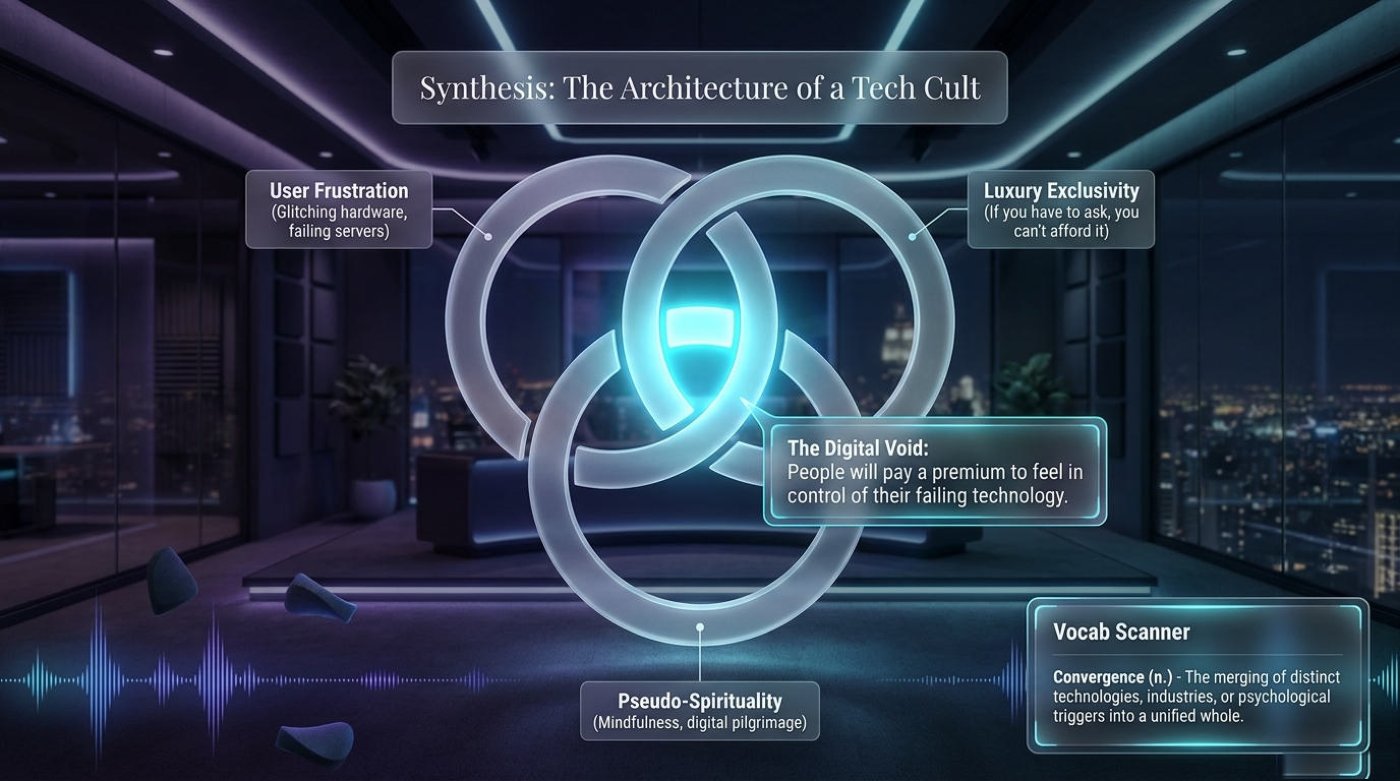
4. The synthesis formula — the anatomy in one equation. The closing diagram states: "User Frustration (Glitching hardware, failing servers) + Luxury Exclusivity (If you have to ask, you can't afford it) + Pseudo-Spirituality (Mindfulness, digital pilgrimage) = The Digital Void: People will pay a premium to feel in control of their failing technology." Convergence, defined as "the merging of distinct technologies, industries, or psychological triggers into a unified whole," names the mechanism. The product is not the router bag or the robe — the product is the feeling of control.
🧠 Comprehension Check: The Interactive Quiz
The quiz below gathers eight questions from the broadcast — definitions in context, true-or-false statements, a fill-in-the-blank line, and details from the ritual. Every answer produces instant feedback with a short explanation, a running score, and a dot trail that records the journey. The Watch it again button resets everything for another attempt.
🎬 The Sign-Off
"People will pay a premium to feel in control of their failing technology."
The broadcast closes with the host promising, over an empty studio, to keep listening. The final Vocab Scanner card defines reverence as "deep respect for someone or something; treating expensive silence as the ultimate luxury," and the sign-off performs the definition — the host sits in silence and calls it luxury.
For a language learner, the takeaway is double. On the surface, thirteen new words now carry vivid stories, and stories are what make vocabulary stick. Beneath the surface, the lesson trains an ear for euphemism, spin, and marketing register — the ability to hear when English is describing a product and when it is describing a feeling. That listening skill transfers directly to meetings, advertisements, and keynotes far beyond this fictional cult.
Replay the broadcast, revisit the presentation, and retell the initiation ritual to a friend using at least five of the new words. Then hum a specific, atmospheric frequency for good luck — the lag gods appreciate commitment. 📌
📎 Lesson Files
Open the original lesson materials in a new tab and follow along with the broadcast: